
Why More Marketing Data Isn’t Producing Better Decisions
Marketers have more data, more sophisticated measurement tools and more AI-powered analytics than ever. Ebiquity Global CEO Ruben Schreurs believes the next challenge isn’t measuring more. It’s building organizations capable of acting on what they already know.
Marketers have never known more.
They have more data, more dashboards, more attribution tools, more sophisticated modeling and, increasingly, more AI-powered analytics capable of finding patterns at speeds that would have been unimaginable even a few years ago.
And yet all of that knowledge isn’t necessarily producing better decisions.
New research from Ebiquity and the World Federation of Advertisers (WFA) points to a striking disconnect. Eight in ten advertisers use marketing mix modeling, yet only about 15% of senior marketing leaders surveyed say effectiveness outputs are the primary driver of budget decisions.
For Ruben Schreurs, Global CEO of Ebiquity, those numbers point toward a problem that is becoming less about measurement itself—and more about what organizations do with it.

The Gap Between Knowing and Doing
The research behind the Paid Media Effectiveness Handbook draws on a quantitative survey of 71 senior leaders across ten sectors, together responsible for approximately $40 billion in paid media, as well as 22 in-depth interviews with CMOs, effectiveness leaders and finance partners.
What emerged wasn’t a lack of measurement.
Most large advertisers already have plenty of it. The harder problem is turning evidence into decisions.
Different parts of an organization may be optimizing successfully against their own objectives without necessarily understanding how those measures contribute to larger business goals such as revenue or brand equity. In our conversation, Schreurs emphasized the need for structural alignment and a unified language that connects platform metrics with business performance.
The handbook calls this the gap between knowing and doing.
And importantly, when researchers asked what prevents measurement from influencing investment decisions, methodology ranked behind short-term commercial pressures, late-arriving insights, interventions from finance or procurement and lack of trust in results.
In other words, the biggest barriers weren’t primarily technical.
They were organizational.
When Everyone Has a Different Definition of Success
ROI. ROAS. Effectiveness. Efficiency. Short-term performance. Long-term brand value.
The vocabulary is familiar. Agreement about what those words mean—and how they should influence decisions—is another matter.
Catherine Masson of Air France captured the problem particularly well in the research:
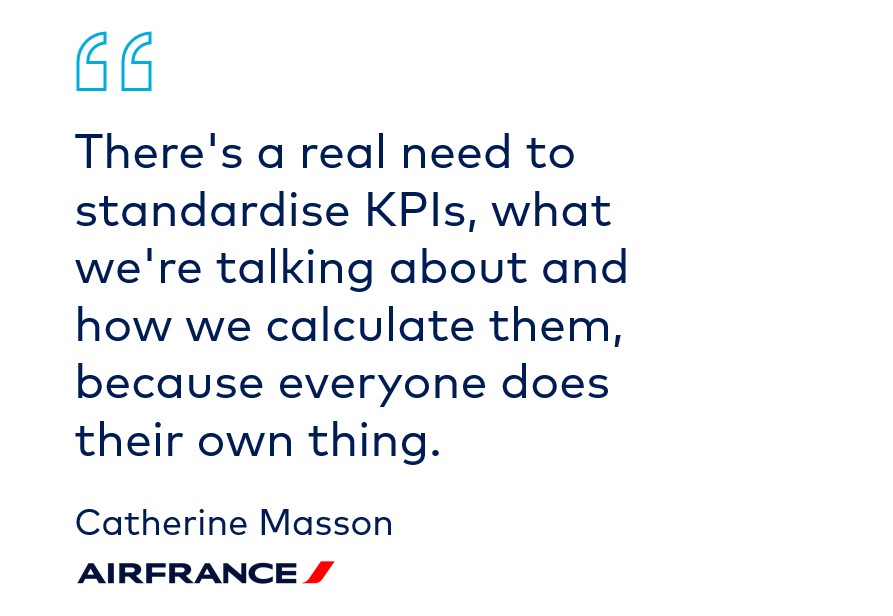
“There’s a real need to standardise KPIs, what we’re talking about and how we calculate them, because everyone does their own thing.”
The handbook argues that when media, analytics and finance use the same terms differently, debates about performance can quickly become debates about definitions rather than evidence. Air France’s experience suggests that standardizing KPIs can also change the quality of conversations with finance and senior leadership.
That distinction matters.
If the problem is assumed to be methodological, the natural response is another model, another platform or another source of data.
But if the problem is organizational, another tool won’t necessarily solve it.
The Missing Piece May Be the System Around the Tools
This is where the Ebiquity/WFA research becomes more interesting than a conventional discussion of media measurement.
Its argument is essentially that measurement needs an operating system around it.
Who owns the outputs? How often are they reviewed? Which decisions should they influence? What happens when different methodologies produce conflicting signals? And who ultimately has the authority to act?
The handbook organizes that system around four connected dimensions:
Metric Clarity — What
A shared vocabulary and common definitions of success.
Measurement Toolkit — How
Connecting different measurement methods to the questions they are best equipped to answer.
Decision Discipline — So what
Ensuring evidence actually reaches decisions rather than ending its life in a report or presentation.
Commercial Bridge — Why it matters
Connecting marketing effectiveness to finance and the wider business.
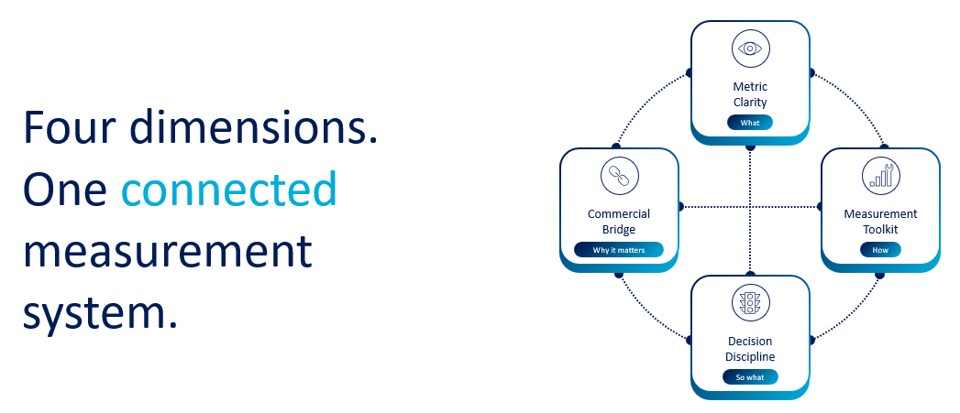
Only one of those four dimensions is primarily about the mechanics of measurement.
The others are about how organizations communicate, make decisions and connect marketing activity to business outcomes.
That helps explain why Schreurs sees the answer not as more measurement, but as greater discipline around how measurement is used.
From Measurement to Business Language
Perhaps the most revealing gap is between marketing and finance.
The research found far stronger alignment between marketing and its agency partners than between marketing and finance—a reminder that the people closest to marketing measurement may understand one another while those ultimately responsible for broader commercial decisions may be speaking a different language.
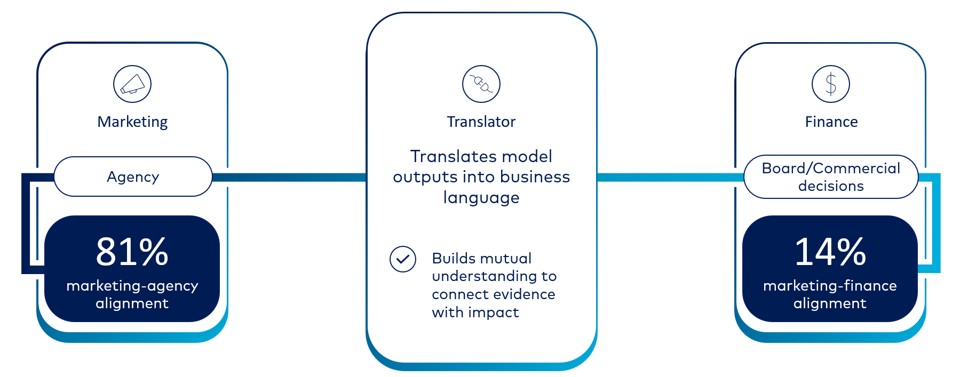
This creates a new kind of requirement for marketers: the ability to translate.
A media effectiveness result isn’t valuable simply because it is statistically robust. Someone has to explain what it means for growth, profit, risk, future demand or enterprise value.
In our conversation, Schreurs repeatedly returned to this need to connect marketing investment with the larger business—and to create decision structures before short-term pressures arrive and override them.
The implication is significant.
In an era of increasingly abundant information, interpretation may be becoming as important as measurement itself.
And Then There’s AI
Artificial intelligence would seem to offer an obvious answer to a world overflowing with data.
AI can process more information, connect previously separate sources and increasingly participate in workflows and decision processes. Schreurs sees enormous potential there.
But he also makes an important distinction: organizations need clarity about what they want AI to do and where it genuinely adds value.
The research makes the point even more starkly: without metric clarity, reliable data and decision discipline, AI can accelerate noise rather than value.
That turns the usual AI conversation on its head.
More computational capability doesn’t automatically create greater organizational intelligence. If objectives are unclear, definitions conflict or no one knows who owns the resulting decision, faster analysis can simply get an organization to confusion more quickly.
The technology may change dramatically. The need for clarity doesn’t.
What the Moon Landing Got Right
Toward the end of our conversation, Schreurs reached for an unexpected analogy.
The 1969 moon landing.
NASA had a fraction of today’s computing power and nowhere near today’s abundance of data. Yet an extraordinarily complicated mission succeeded because there was clarity about the objective, defined roles and a disciplined structure for making decisions.
Ruben Schreurs’ point isn’t that marketers need less technology.
It’s that technology works best when it serves a clearly understood mission.
What are we trying to accomplish? What role does marketing play? Which evidence matters? Who makes the decision? And what happens next?
Modern marketing, he suggests, may need its own version of mission control—a system that connects information, people and decisions around a clearly understood objective.
Perhaps that’s the larger lesson buried inside a study about paid media effectiveness.
For years, marketers have been encouraged to become more data-driven. The result has been extraordinary advances in what organizations can measure.
The next challenge may be different.
Not simply knowing more—but becoming much better at deciding what all that knowledge means, and what to do next.