
When Time Is No Longer the Measure of Agency Value
New research from the World Federation of Advertisers and Agency Mania Solutions reveals how agency compensation is changing, why AI is accelerating the transition, and what marketers are increasingly willing to pay for.
For decades, time has been one of the most familiar currencies of the advertising business. Agencies assembled teams, estimated hours, negotiated staffing levels and built compensation agreements around the people and time required to deliver the work.
That currency is losing its dominance.
How Brands Define, Scope and Reward Agency Work from the World Federation of Advertisers (WFA), conducted with Agency Mania Solutions, documents a remarkable 15-year shift in how multinational marketers compensate their agencies. In 2011, 54% of respondents used labor-based compensation as their primary model. By 2026, that figure had fallen to just 19%.
Over the same period, fixed-fee or output-based models rose from 20% to 33%, while labor-plus-performance arrangements more than doubled, from 9% to 21%.
The findings come from 69 multinational companies with a combined estimated global marketing spend of $147 billion. Most respondents work in global marketing procurement, providing an important perspective on how large advertisers are reassessing the economics of agency services.
The shift is substantial. But the more interesting question may be what is replacing the traditional relationship between time, effort and value.
1. The Move from Hours to Outcomes Is Accelerating
The WFA research, How Brands Define, Scope and Reward Agency Work, suggests that marketers increasingly want compensation models that reflect what agencies deliver rather than simply the resources required to deliver it.
And the transition is far from complete.
Looking ahead, 63% of respondents anticipate increasing their use of performance-based compensation. Another 46% expect greater use of value-based models, while 36% foresee increased reliance on fixed-fee or output-based arrangements.

These approaches are not interchangeable.
An output might be a campaign, a content asset or a completed production assignment. An outcome might be a measurable improvement in brand performance, customer acquisition or another agreed business objective. Value-based compensation attempts to reflect the worth of the contribution rather than simply the cost of producing it.
Each requires different assumptions about accountability, measurement and risk.
For now, the industry’s ambition to reward performance is running ahead of its implementation.
Although 47% of respondents report using outcome- or performance-related remuneration, such incentives typically represent a relatively small proportion of agency fees. Across most disciplines, between 67% and 80% of respondents using these arrangements say performance-based remuneration accounts for less than 20% of total compensation.
The direction of change may be increasingly clear. The destination is not.
2. AI Is Making the Old Economics Harder to Defend
Artificial intelligence adds a new urgency to a transition that began long before generative AI entered everyday marketing conversations. When research, production, adaptation, analysis and other activities can be completed more quickly, the relationship between hours invested and value delivered becomes increasingly difficult to sustain.
Yet the WFA findings reveal a considerable gap between the expectation of change and its commercial reality.
Only 20% of respondents have begun evolving their agency commercial or remuneration models in response to AI, although 61% intend to do so. Meanwhile, 82% agree that poor agency use of AI could cause them to reconsider retaining a partner on their roster.
In other words, AI capability is rapidly becoming an expectation, even before many organizations have determined how its benefits should be priced.

The question of who benefits from greater efficiency is particularly revealing.
- Among respondents, 33% report receiving reduced fees or credits reflecting lower production costs. Others describe different outcomes: 23% report higher-quality work or faster turnaround at the same cost, while 17% receive additional agency time or resources without an additional charge.
- But 25% say they have not yet discussed AI efficiencies with their agencies, and 23% report insufficient visibility into how agencies are using the technology.
- Only 8% report shifting toward value- or output-based pricing as a result of these efficiencies.
This raises a commercial question that cannot be answered by automation alone: when technology reduces the effort required to produce work, should the benefit appear as lower costs, greater output, better quality or more valuable strategic contribution?
The answer may differ by assignment. But without an explicit understanding of how productivity gains are measured and shared, AI risks becoming another source of disagreement about price rather than a source of mutual value.
3. What Marketers Expect & What They Will Pay Extra For
Perhaps one of the report’s most revealing findings concerns the distinction between capabilities marketers consider essential and those for which they are prepared to pay a premium. Expectations have risen considerably.
Agility is considered a standard requirement by 83% of respondents. Creative and innovative thinking follows at 79%, strategic thinking at 72%, high-caliber talent at 71%, and effective AI capabilities at 66%. These are no longer necessarily differentiators. Increasingly, they are the price of admission.
Yet the capabilities that attract additional compensation tell a more selective story.
Just 22% identify exceptional talent as worth paying extra for, followed by distinctive strategic thinking at 20% and specialized expertise at 17%. Only 4% indicate a willingness to pay a premium specifically for effective AI capabilities. That distinction matters.
AI may be transforming the way agencies operate, but marketers appear reluctant to pay a premium merely because an agency uses it. They increasingly expect technological competence as part of the basic service.
The potential for differentiation lies elsewhere: in the quality of judgment, the originality of thinking, the depth of expertise and the ability to apply capabilities to a business problem.
For agencies, this presents a challenge. When more capabilities become standard expectations, demonstrating exceptional value becomes more difficult — and potentially more important.
4. The Transformation Is Not Happening Evenly
The research also makes clear that there is no single global agency compensation model emerging. Different disciplines lend themselves to different commercial approaches.
Fixed-fee or output-based arrangements dominate creative ad-hoc assignments at 58% and production at 61%, where deliverables can often be defined and priced with relative clarity.
Media remains more varied. Labor-plus-performance models account for 41% of media planning arrangements, 34% of media buying and 30% of paid social.
Performance-linked remuneration is also more common in media than in creative and production: 67% of media respondents report using such arrangements, compared with 27% in creative and production.
This distinction is understandable. Certain media outcomes can be measured more directly, while isolating the contribution of creative thinking from product, pricing, distribution and market conditions is more difficult.
Geography adds another layer.
In the United States and Canada, labor/FTE remains the most common model at 38%, compared with 29% for fixed-fee or output-based arrangements. Europe has a more diversified mix, with fixed-fee or output-based compensation leading at 32%. Asia Pacific is further oriented toward that approach, at 44%.
The regional differences suggest that the transition is neither uniform nor inevitable at the same pace everywhere. Commercial traditions, procurement practices, agency disciplines and market expectations all influence the direction of change.
For multinational advertisers managing agency relationships across markets, that complexity is particularly significant.
5. The Value Paradox
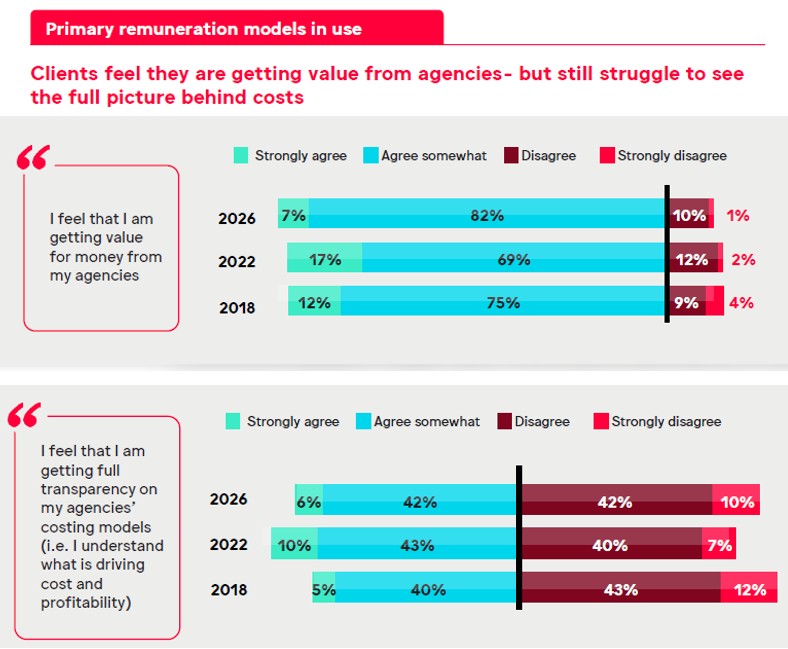
One of the report’s most intriguing findings is that 89% of respondents believe they receive value for money from their agencies. Yet only 48% say they have sufficient transparency into agency costing and profitability. The gap is especially pronounced in creative and production, where 90% recognize value but only 41% report sufficient cost transparency.
These findings complicate the assumption that greater cost visibility necessarily produces a clearer understanding of value.
Marketers can recognize the contribution agencies make without fully understanding the economics behind it. Equally, agencies can provide detailed staffing and cost information without necessarily demonstrating the business value of their work.
This is where the movement away from hours becomes especially consequential.
If time and staffing are no longer the primary measures of compensation, both sides need greater clarity about what is being purchased, how its value is assessed and how commercial expectations change when the scope of work evolves.
And there is another economic pressure beneath the discussion.
The WFA study finds that average agency payment terms have lengthened from approximately 65 days in 2022 to roughly 75 days in 2026 across most agency categories. Nearly half of respondents report extending payment terms for media agencies over the previous 18 months.
For smaller agencies and specialist partners, longer payment cycles can create real working-capital pressures, particularly when they must finance talent, production or third-party services before receiving payment.
The question of agency value therefore extends beyond how fees are calculated. It also involves whether the financial arrangements supporting the work are sustainable.
6. Better Compensation Cannot Substitute for Better Work
Despite the report’s emphasis on commercial transformation, one of its clearest findings concerns the conditions that make agency performance possible.
When respondents were asked what contributes most to high-performing work, great briefing ranked first, scoring 5.6 out of 6. Respect and trust followed at 5.2, with high-quality feedback and clarity of roles both at 5.1.
Financial incentives scored considerably lower, at 3.9.
These priorities are consistent with the findings from 2022.
This does not suggest that compensation is unimportant. Rather, it indicates that sophisticated payment structures cannot compensate for poorly defined objectives, unclear responsibilities or inadequate direction.
Indeed, 76% of respondents agree to some degree that changing their current remuneration models would improve agency relationships.
The implication is not that marketers should abandon the pursuit of better commercial models. It is that those models must be supported by clearer scopes, more effective working practices and better definitions of success.
Paying differently is not, by itself, the same as creating greater value.
What Comes After the Billable Hour?
The WFA findings describe an industry in transition rather than one that has settled on a new economic model.
Time-based compensation is declining. Performance and value-based approaches are gaining momentum. AI is changing the cost and speed of production, while marketers increasingly expect technological competence as standard.
But the research also reveals how much remains unresolved. What constitutes an output? Who determines an outcome? How should the value of strategic thinking be measured? How should agencies and clients share the benefits of automation? And how can commercial models reward contribution without creating incentives that undermine the quality of the work?
There is unlikely to be a single answer across every discipline, market or assignment. Perhaps the most consequential change is not simply that agencies are being paid differently. It is that marketers are being forced to become more precise about what they actually value.
When time is no longer the measure, the definition of value matters more than ever.
Source: World Federation of Advertisers and Agency Mania Solutions, How Brands Define, Scope and Reward Agency Work, September 2026. Findings are based on a June 2026 survey of 69 multinational companies representing an estimated $147 billion in combined marketing spend. Figures reflect the revised September report.