
Joanne Davis: Walk in the Other Guy’s Shoes
Why seeing the marketing, procurement, and agency triangle from all three sides matters.
For decades, the marketing industry has talked about improving the client-agency relationship.
Joanne Davis thinks we may have been leaving someone out.
In her new book, Walk in the Other Guy’s Shoes: 25 Lessons for the Marketing, Procurement, and Agency Triangle, Davis asks marketers, procurement professionals, and agencies to consider something deceptively simple: What does the relationship look like from the other person’s point of view?
It’s a question grounded in decades of experience. Davis has spent her career helping marketers and agencies find one another, work together, compensate one another—and sometimes understand why relationships that looked right on paper weren’t working quite as intended.
But while developing her second book, she found herself reconsidering a word the industry uses almost automatically: client. Her first book focused on “Client and Agency.”
This time, she realized that client actually contains two dimensions: the marketer’s agenda and the procurement agenda. And the gaps between marketing and procurement, procurement and agency, and marketing and agency aren’t necessarily the same.
That changes the picture. It’s no longer simply a relationship between two sides. It’s a triangle.
Why This Book, Now?
Davis has a gift for making complicated relationship problems sound deceptively simple.
And Walk in the Other Guy’s Shoes may be her simplest proposition yet: marketers, procurement professionals and agencies come to the relationship with different responsibilities, pressures, expectations and definitions of success. Better relationships begin when each understands how the other person sees the world.

That doesn’t mean the three sides will—or should—always agree. It means understanding what the person across the table is actually being asked to accomplish.
And that’s where Joanne’s shoes come in.
A Year’s Worth of Reasons to Look Again
This isn’t a conventional management manual.
Instead, Davis turns the calendar into a year-long guide to better relationships.
New Year’s. Valentine’s Day. The Super Bowl. Mother’s Day. Halloween. Thanksgiving. Even Star Wars and The Sound of Music provide occasions to reconsider how marketing, procurement and agencies work together.
The device is playful. The issues underneath it aren’t.
Briefing. Compensation. Feedback. Agency reviews. Transparency. Talent. AI. Trust. Ghosting. Gratitude.
And, occasionally, something as basic as remembering to say thank you.
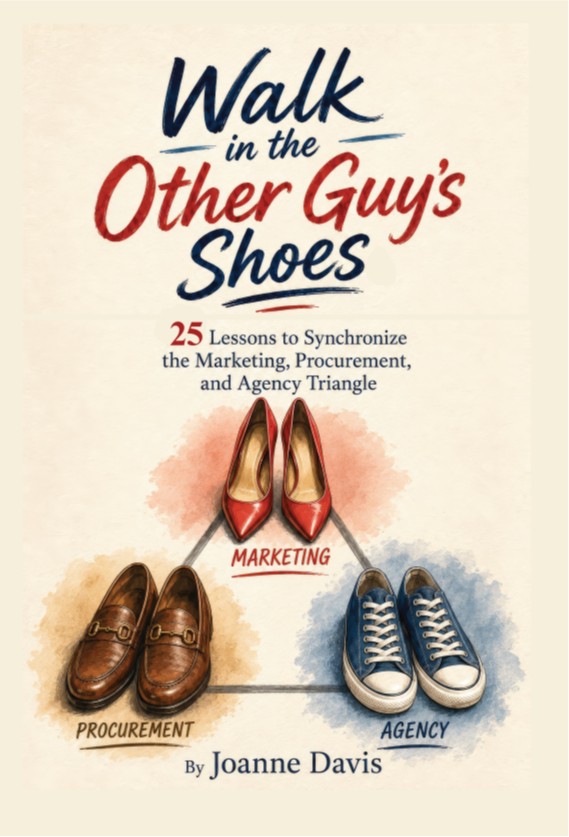
The result is 25 lessons that can be read individually throughout the year but collectively make a larger point: relationships rarely break down because nobody knows that communication or respect matters. They break down in the small moments when one side experiences something very differently from the way another side intended it.
Procurement Isn’t the Supporting Character
One of the book’s most important distinctions is right there in the subtitle: Marketing. Procurement. Agency. Not client. Agency.
For Joanne Davis, procurement isn’t simply the function that enters at the end to negotiate a contract or question a cost. Procurement is part of the relationship—and agencies need to recognize that, too.
Her advice to agencies is wonderfully direct: “They’re your clients too.”
She’d like agencies to invite procurement inside. Show them how the work gets made. Explain the creative process. Let them see the studios, the tools and increasingly the AI capabilities changing agency operations.
Her reasoning is equally straightforward: How can you buy something you don’t know?
That responsibility runs in both directions. Procurement needs to understand what it’s buying. Agencies need to help procurement understand it. And marketers need to recognize the different pressures each brings to the table.
Joanne even gives the idea a name: Take Procurement to Agency Day.
It sounds lighthearted. It isn’t a bad prescription.
The Human Part Hasn’t Gone Away
Perhaps the most striking thing about her advice is how little of it depends upon the latest marketing technology. That’s particularly interesting now.
AI is changing how work gets done. Agency models continue to evolve. Organizations face increasing pressure to move faster, become more efficient and demonstrate results. Roles are changing, expectations are changing, and questions about value are becoming more complicated. The book itself argues that these changes make collaboration across the triangle more important, not less.
Yet Joanne keeps returning to something considerably more fundamental: People work with people. Brands don’t work with agencies. Companies don’t work with procurement departments. People work with people.
And people need to listen. Explain. Respond. Give feedback. Understand pressures other than their own. Respect expertise. Occasionally admit when something isn’t working.
Technology may change the mechanics of marketing. It hasn’t eliminated the human relationship underneath it.
“We’re All in It Together”
For all the different agendas around the triangle, Joanne Davis ultimately brings them back to one shared objective: The success of the business. The brand. The company.
That’s easy to say. Harder to remember when a marketer is pushing for growth, procurement is answering to financial and organizational demands, and an agency is trying to deliver strong work while running a healthy business.
Perhaps that’s why the title matters more than it initially appears to.
Walk in the Other Guy’s Shoes isn’t asking everyone to agree. It’s asking them to understand enough about the other two perspectives to work together more effectively.
And in a business increasingly preoccupied with what technology can do next, Joanne Davis offers a rather human reminder about what people might do better now.
Sometimes changing a relationship starts by changing shoes.
WATCH THE FULL TRENDSETTERS CONVERSATION
Deborah Malone talks with Joanne Davis about why she wrote Walk in the Other Guy’s Shoes, why procurement belongs in the relationship from the beginning, what decades of agency search and relationship work have taught her—and why seeing the world from another person’s perspective still matters.

WATCH / LISTEN | Joanne Davis on Why Walk in the Other Guys’ Shoes
NEW FROM INTERNATIONALIST PRESS
Walk in the Other Guy’s Shoes: 25 Lessons for the Marketing, Procurement, and Agency Triangle
By Joanne Davis