The Revenue Brands Keep Overlooking
Why the 50+ opportunity is still underestimated—and what’s beginning to change …
The 50+ audience is described as the most valuable consumer segment in the market (Nielsen).
- $6 trillion in spending.
- Majority of discretionary income.
- Overwhelming disproportionate wealth (80%).
And yet, it rarely shows up as the starting point for growth. Not in strategy. Not in creative. And not even in how success is measured.
The issue isn’t visibility.
It’s interpretation.
The Gap Isn’t Where We Think It Is
The conversation around the 50+ market has always focused on inclusion—whether this audience is being represented at all.
But today that framing is too narrow.
Because even when 50+ consumers are visible, they are often:
- Overly simplified
- Stereotyped from a bygone age
- Or treated as a “life stage” rather than a dynamic, evolving identity
Which leads to a deeper disconnect: Brands aren’t just underrepresenting this audience. They’re misreading it. And that misreading has consequences—not just culturally, but commercially, economically.
From Perception Gap to Revenue Gap
What’s been harder to quantify—until recently—is what that misalignment actually costs.
New tools are beginning to make the gap visible in economic terms.
The V925 Silver Gap App, developed by Lee Brody, of BGC Strategies as part of the Vantage 925 Protocol, reframes the 50+ market not as a demographic segment, but as an actionable business opportunity. It highlights where brands are under-indexing relative to this cohort’s spending power and their interest in the brand and category.
Its premise is straightforward: If a group represents a disproportionate share of spending—but is not proportionately reflected in targeting, messaging, or experience design (collectively friction)— there is a gap between potential value and realized value.
That gap may be larger and more concentrated than most organizations assume.
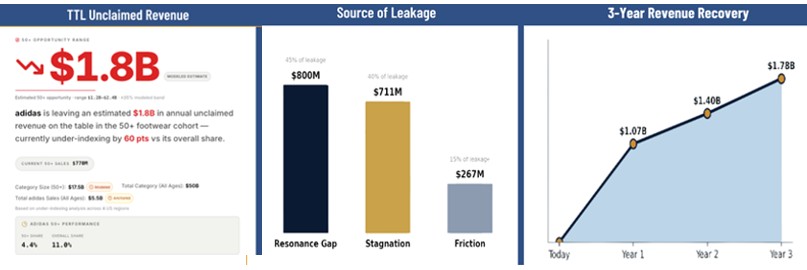
Adidas is leaving $1.8 Billion on the table by under-indexing the 50+ cohort by 60 points vs. its overall Athletic Footwear share.
Why Brands Still Miss It
If the economics are so clear, why does the disconnect persist?
Because most marketing systems are still built around outdated assumptions about age, relevance, and aspiration.
- Youth is a proxy for growth; Age means decline
- And 50+ consumers are often grouped into a single, undifferentiated population when the differences are profound.
The reality, though, looks very different.
Today’s 50+ audience is:
- Professionally active
- Digitally fluent
- Socially and culturally engaged
- Redefining what later life looks like in real time
The issue isn’t access to data. It’s the lens through which that data is interpreted.

A Shift in How Opportunity Is Measured
This is where the conversation changes.
Rather than asking:“How do we reach the 50+ audience?”
More brands will need to ask: “Where are we underestimating the role the 50+ audience plays in our business?” and “How can we get more of them to buy our brand?”
That shift takes longevity from a hypothetical targeting question to a growth imperative.
And it requires a different set of tools—and a different mindset. Tools like the V925 Silver Gap App quantify the scale of the opportunity.
It also points to a broader need: To rethink how marketers can elevate relevance, value, and participation across age.
The Right Question
The longevity economy is already here.
What’s still lagging is how it’s understood and acted upon.
And for many brands, the most important question may no longer be: “How do we grow?”
But: “What are we not seeing?”
Interested in exploring your brand’s potential 50+ revenue gap?
A limited number of complimentary V925 Silver Gap App assessments are being offered through Vantage 925 for brands interested in understanding how longevity may be influencing growth and perception.
GenMORE+ is The Internationalist’s ongoing exploration of how brands are redefining relevance, participation, and value in a world where longevity is reshaping modern life.