When Efficiency Becomes Easy, Difference Becomes Scarce
After 17 years of studying what makes brands meaningful, Havas’ Mark Sinnock is asking a different question: What makes them worth choosing… and, in an age of AI abundance, worth choosing again?
Marketing has never had more ability to make more things.
More content. More personalization. More optimization. More precise targeting. More interactions across more touchpoints, produced and distributed faster. And AI is accelerating it all.
So why are so many brands becoming easier to ignore?
It is a question that sits at the intersection of two substantial new bodies of Havas research … and nearly two decades of thinking about what makes brands matter.
For 17 years, Meaningful Brands examined the role brands play in people’s lives and the value people expect them to create beyond an immediate transaction. Its successor, The Science of Desire, asks what turns that value into something more powerful: motivation, choice and ultimately growth.
Now a second Havas study, Avoiding the AI Efficiency Trap, raises the stakes.
It doesn’t introduce an entirely new problem so much as intensify an old one. If indifference was already the challenge, AI gives marketers unprecedented power either to escape it—or manufacture more of it, faster.
For Mark Sinnock, Global Chief Strategy, Intelligence and Innovation Officer at Havas Creative Network, these ideas are connected. And together, they point toward a larger change in what building a brand may increasingly require.
Presence Is Not Progress
One of the most provocative findings from The Science of Desire is also one of the simplest: 84% of brands suffer from indifference.
Not dislike. Indifference. They are known but unloved. Present but replaceable.
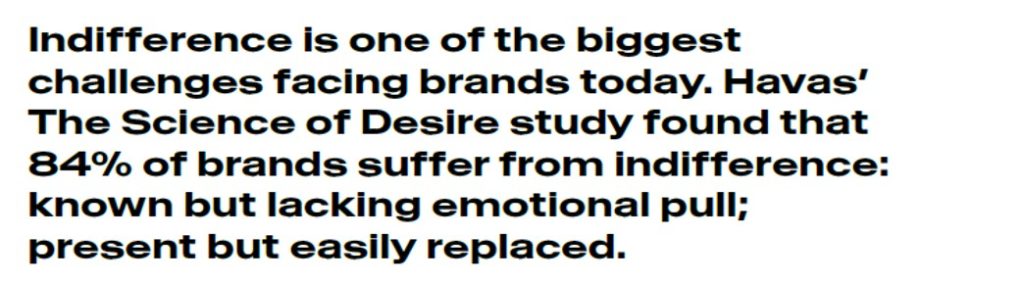
That distinction matters at a moment when marketers have extraordinary tools for creating presence.
“Brands have never had more capability to create presence,” says Mark Sinnock. “We have more data, more content, more touchpoints and increasingly sophisticated systems for reaching and converting people. But presence can easily be mistaken for progress.”
In a world of information abundance, Havas’ work in behavioral science suggests people aren’t simply paying less attention. They are becoming better at filtering.
Brands that fail to create sufficient motivational pull simply disappear into the middle. And optimization may be making the problem worse.
“As marketers optimise repeatedly towards similar signals and outcomes, efficiency can improve while difference is steadily flattened,” Sinnock says.
That may be one of the defining paradoxes of marketing now: We are getting better at reaching people at precisely the moment it is becoming harder to give them a reason to care.

“Meaning has not become less important.”
Mark Sinnock – Global Chief Strategy, Intelligence and Innovation Officer, Havas Creative Network
Meaning Didn’t Disappear. It Moved.
The transition from Meaningful Brands to The Science of Desire could easily be interpreted as a change of philosophy. Mark Sinnock sees it differently. “Meaning has not become less important. It remains part of the value brands create.”
What has changed is the question.
Meaningful Brands explored the functional, personal and collective value people expected brands to deliver. But recognizing that a brand is useful, responsible or relevant does not automatically make someone want it, choose it—or return to it.
So Havas began asking what turns perceived value into action. Working with behavioral scientist Lea Karam, the research identifies three interconnected forces:
- Attraction creates the immediate pull.
- Affinity connects a brand with who we are, what we value and where we feel we belong.
- Attachment builds the enduring bond created through trust, consistency and repeated positive experience.
Importantly, these aren’t steps in a funnel. They operate together.
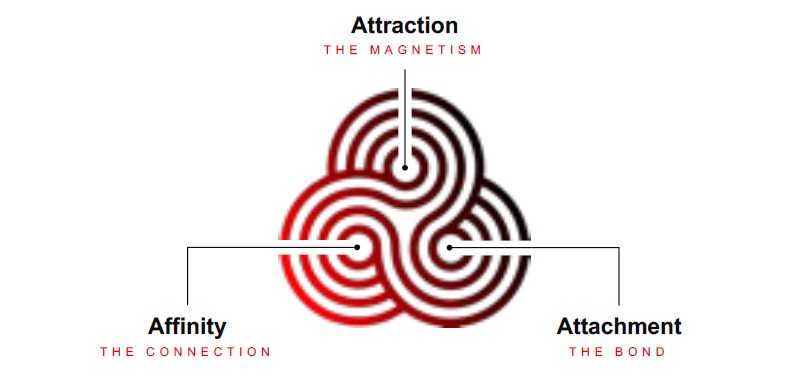
The Science of Desire identifies three interconnected forces behind brand desire: Attraction, Affinity and Attachment. Source: Havas, The Science of Desire, 2026.
Havas found that brands strengthening all three year over year were 2.4 times more likely to achieve growth than the average.
And there is another important implication here for an industry that has spent years debating purpose, authenticity, and trust. Meaning cannot simply be declared.
People experience what a brand stands for through its products and services, its people and partners, the decisions it makes and what happens when something goes wrong.
As Sinnock puts it: “Authenticity cannot be communicated into existence.” It is earned through coherence between what a brand says, what it does, and what people actually experience.
And that becomes especially significant when AI enters the picture…
The AI Efficiency Trap
AI offers marketing something irresistible: the ability to do more, faster, and often at lower cost. But Havas’ newest research suggests that efficiency carries a risk.
Half of the people surveyed across seven global markets agreed that AI used by brands can make things look, feel or sound the same. Havas calls this the AI Efficiency Trap: when AI creates efficiency for the organization without creating enough value for the consumer.
The problem isn’t AI itself. It’s what we’re asking it to optimize.
“If brands use similar technologies to optimise towards similar signals and outcomes,” says Mark Sinnock, “efficiency may improve while distinctiveness declines.”
And suddenly the economics of differentiation begin to change.
AI is lowering the cost of creation, optimization, and distribution. But as those capabilities become available to everyone, efficiency becomes easier to replicate. Difference becomes scarcer. That makes the human-versus-machine debate almost moot.
Havas frames the relationship differently:
Human understanding unlocks the opportunity.
Human creativity is the generative force.
Machine intelligence is the amplifier.
Amplification, however, creates an advantage only when there is something worth amplifying. “As technology becomes more capable,” Sinnock says, “the premium on originality, judgment and emotional distinctiveness rises rather than falls.”
Perhaps the Scarce Resource Is Judgment
This may be where the implications of the research become larger than AI.
- When everyone can generate, who decides what is worth generating?
- When everyone can personalize, who decides whether personalization actually improves the experience?
- When everyone can optimize, who decides whether the thing being optimized is worth optimizing?
- And when technology makes it possible to do almost everything, who knows when not to use it?
Havas’ AI research suggests consumers are already making those distinctions.
AI performs particularly well when it has a clear job to do: helping people understand information, compare choices, make decisions or get support.
Havas identifies three characteristics of valuable AI experiences: Utility, Credibility and Appeal.
Utility gives people a recognizable benefit.
Credibility makes that benefit believable and trustworthy.
Appeal makes the experience engaging and distinctive enough to deserve attention.
Only 9% of the AI-enabled experiences Havas evaluated reached the highest band of its Valuable AI Experience Score. Yet those experiences were associated with 4.4 times higher engagement, 1.6 times stronger Brand Desire and 1.6 times greater growth potential than low-scoring experiences.
The lesson isn’t to automate less. It is to automate with greater judgment.
“The question is no longer simply where AI can be used,” Sinnock says, “but where it should lead, where it should support and where restraint creates more value than automation.”
That word—restraint—may become increasingly important. Because abundance changes the nature of advantage. The ability to produce more is no longer necessarily impressive. Knowing what deserves to exist may be.
“Use machine intelligence to expand what is possible. Use human judgement to decide what is worth doing.”
— Mark Sinnock
From Communicating Value to Creating It
There is one more consequence.
If Desire is built not through communications alone but through everything a person experiences with a brand, then the role of marketing itself begins to change.
Products. Services. Retail. Apps. Customer support. Media. Commerce. Technology. People don’t experience these as organizational silos. They experience a brand. And every encounter either reinforces or contradicts what they have come to expect.
That means marketing cannot simply communicate value created somewhere else in the organization. “Marketing increasingly needs to help shape and connect the interactions through which that value is actually felt,” says Sinnock.
This may require marketers to become more systems-minded: connecting creativity, media, product, service, commerce and technology so that experience reinforces memory, memory shapes behavior and those effects compound over time.
Campaigns don’t disappear in this model. They become interventions within a larger system. And AI makes coherence even more important. As more of the marketing ecosystem becomes generated, personalized, and automated, the danger is not simply bad AI. It is a fragmented brand.
Which brings us back to where we began.
Marketing has never had more tools for creating presence.
But presence isn’t the same as meaning.
Meaning isn’t the same as desire.
And efficiency isn’t the same as difference.
In an age when almost every brand will have access to extraordinary technological capability, advantage may belong to those that exercise something much harder to automate: judgment about what matters, creativity that makes it distinctive, and the discipline to deliver it consistently enough to earn another choice.
“Marketing’s job is not only to give people a reason to choose. It is to help the business keep earning that choice.”
— Mark Sinnock