Global Marketing Fails Operationally Before It Fails Publicly
Kevin Freedman on AI, brand drift—and the growing risk of “international marketing debt.”
Great global marketing tends to be celebrated for the things we can see: the idea, the creative, the media, the results.
Kevin Freedman thinks we should pay considerably more attention to what happens underneath.
“Creative often gets the credit for campaigns and implementation gets the blame,” says the Founder and CEO of Freedman International. As brands expand across markets, he argues, complexity compounds—often remaining largely invisible to senior leadership until something goes wrong.
A campaign created for one market already involves audiences, production, media, approvals and countless decisions. Multiply that across five, 10, 20 or 30 markets—with different cultures, stakeholders, media requirements and time zones—and Freedman describes the challenge as “three-dimensional chess.”
The creative idea may still be perfectly sound. The difficulty is making that idea travel.
And AI is dramatically changing the speed at which all of this happens.
60-second highlight: “Why Global Marketing Fails Before You See It”

AI Makes More Possible. It Also Makes Problems Travel Faster.
Brands can now adapt voices, backgrounds and talent, reformat creative and produce localized variations in seconds. Things that once required considerable time and production budgets can happen almost instantly.
Freedman sees enormous opportunity in that capability. But also a less discussed consequence.
“I think what AI has done is actually made the underlying problems visible faster.”
The old production constraints created friction—but that friction also allowed time for checks and guardrails. Today, teams around the world can independently create content they believe is useful and necessary at extraordinary speed.
At a recent Freedman International roundtable, one participant described this phenomenon as “shadow AI”—teams using AI to create what they need without necessarily seeing what those individual decisions may mean for the larger brand.
It raises a deceptively simple question:
In all that new production, what problems might you also be storing up?
And that’s where another of Freedman’s ideas becomes particularly interesting.
Are You Accumulating International Marketing Debt?
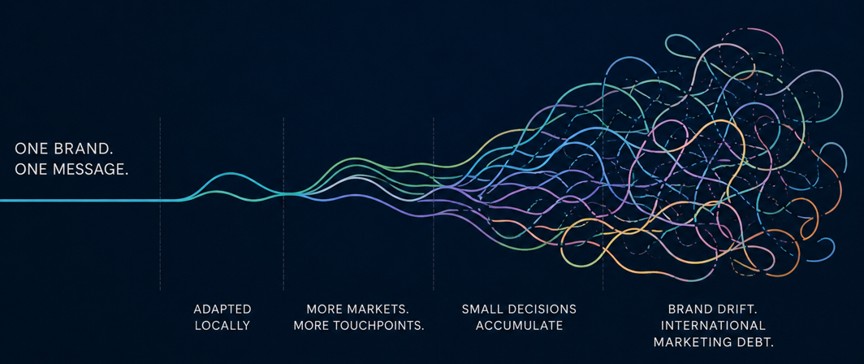
Freedman calls it international marketing debt.
The idea borrows from technical debt in software development, where small compromises or redundancies accumulate within code and eventually create problems someone will have to address.
Brands, he argues, can accumulate debt in much the same way.
A decision in one market is slightly off target. An adaptation in another channel doesn’t quite reflect the brand. A local execution makes perfect sense on its own but moves another small step away from the whole.
Touchpoint by touchpoint. Market by market. Channel by channel. Campaign by campaign.
Individually, none may matter very much.
Over one, two or three years, they can.
The brand begins to drift.
AI potentially accelerates that drift because there are simply more opportunities to create, adapt and make decisions at speed.
For established global brands with decades of equity, an occasional misstep may be relatively easy to absorb. For newer brands still establishing what they stand for, the consequences can be greater—particularly when mistakes can travel as quickly as the content itself.
“AI is amazing as an amplifier,” Freedman says, “both of opportunity and risk.”
When Process Starts Looking Like Strategy
That led our conversation to another question: as marketers race to adopt AI and build faster, more automated ways of working, are we sometimes confusing better process with better strategy?
Freedman sees AI as an extraordinarily powerful operational tool—but cautions against allowing the technology itself to become the objective.
The fact that a brand can now deeply localize creative for individual markets or even particular audiences—changing scenery, scripts, talent and other elements through generative AI—doesn’t necessarily mean it should.
The strategic questions have to come first.
- What should this brand stand for?
- Does that positioning travel across markets?
- Where should it adapt to remain culturally relevant—and what should remain constant?
Only then does the question become: how can AI and automation help make that strategy possible?
Scaling Without Losing the Brand
So how does a brand grow from five markets to 10, 20 or 50 without accumulating the fragmentation Freedman describes?
His answer begins with clarity about what the brand stands for and whether that positioning genuinely resonates in different markets.
Then organizations need the infrastructure behind global execution—the people, capabilities, systems and guardrails that allow campaigns to remain both recognizable and culturally relevant across markets and touchpoints.
And that infrastructure has to scale with the business. New markets, new products and new distribution create new opportunities—but also new places for seemingly small decisions to pull the brand in different directions.
Finally, Freedman argues for something that can be particularly difficult amid the pressure of quarterly results: keeping sight of long-term brand equity.
Perhaps that’s the larger lesson.
AI is giving global marketers extraordinary new capabilities to create more, adapt faster and localize with a degree of precision that would have been unimaginable only a few years ago.
But greater capability doesn’t necessarily create greater coherence.
As the mechanics of global marketing become easier, the judgment required to keep a brand meaningfully intact may become more important than ever.
And that leaves global marketers with a deceptively simple question:
How do you make sure a great idea is still the same great idea by the time it reaches the world?