
Most Marketers Value Creative Excellence. Few Deliver It Consistently.
Why the industry’s challenge may not be creativity itself—but the systems required to scale it.
Most marketers believe creativity drives growth.
Far fewer believe their organizations consistently deliver it.
That is one of the most striking findings from new research by the World Federation of Advertisers (WFA) and Cannes LIONS, released as the industry gathers in Cannes to debate the future role of artificial intelligence in marketing.
According to the study, only 30% of multinational marketers say their organizations consistently work to deliver creative excellence. More than half (53%) say they value creative excellence, but admit that prioritization and execution remain inconsistent across teams.
The finding points to a significant gap between aspiration and reality.
Creativity has long been recognized as one of marketing’s most powerful drivers of effectiveness. Yet many organizations continue to struggle with the practical challenge of embedding creative excellence across increasingly complex global businesses.
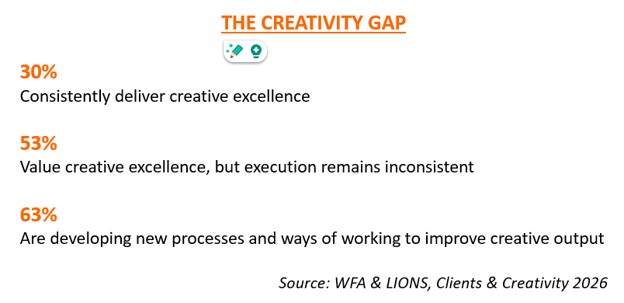
The Creativity Gap
The research, based on interviews with more than 160 senior marketers representing 86 global brands and $141 billion in annual marketing investment, suggests that the challenge is not a lack of belief in creativity.
Rather, it is the difficulty of operationalizing creativity consistently across teams, markets, agencies, and organizational structures.
Many organizations continue to face familiar barriers.
Short-term pressures.
Risk aversion.
Resource constraints.
Competing priorities.
Nearly seven in ten respondents identified short-termism as one of the biggest obstacles to creative excellence, while 45% cited organizational risk aversion.
The result is a situation in which creativity is widely celebrated but often inconsistently practiced.
Excellence Is Becoming a Systems Challenge
One of the most interesting findings in the study is how organizations are responding.
The most common initiatives are not focused on finding more creative ideas. They are focused on creating better conditions for creativity to succeed.
Nearly two-thirds of respondents say they are developing new global processes and ways of working to improve creative output. Others are involving agencies earlier in campaign development, building creative excellence into capability programs, or establishing creative councils to challenge and improve work.
In other words, creative excellence is increasingly becoming a systems challenge.
The question is no longer simply whether organizations can generate strong ideas.
It is whether they can consistently support, scale, and sustain those ideas across increasingly complex marketing environments.
This may be one reason why creative excellence remains elusive for so many organizations. Creativity thrives on talent and inspiration, but it also depends on structures, processes, capabilities, and cultures that allow great ideas to travel successfully across teams, markets, and channels.
The AI Paradox
This context makes the study’s AI findings particularly interesting.
While AI is expected to dominate many Cannes conversations, relatively few organizations appear to be using it primarily to improve creative effectiveness.
Only 35% say they are using AI to drive better creative outcomes beyond efficiency gains.
Most organizations remain focused on productivity, speed, and operational improvements.
Only 11% report having a common vision or game plan for using AI to drive creative excellence.
At the same time, concerns about creative sameness remain widespread.
Many marketers worry that AI could contribute to what one respondent described as a “sea of creative sameness.”
The concern is understandable.
Creating more content has become easier.
Creating distinctive content remains difficult.
From Efficiency to Effectiveness
Perhaps the most important finding is that many marketers believe the industry may be focusing too heavily on efficiency.
Nearly two-thirds say the C-suite is pushing for overly optimistic efficiency savings from AI, while many worry that effectiveness risks being overshadowed in the process.
This reflects a broader tension facing marketing organizations today.
Technology can accelerate production.
It can streamline workflows.
It can improve speed.
But it cannot replace the strategic judgment, cultural understanding, and human insight that underpin breakthrough ideas.
As one respondent noted in the report:
“AI polishes the average; humans provoke the extraordinary.”
That may be one of the most important lessons emerging from Cannes this year.
Creativity Still Matters
Despite the challenges, the study remains surprisingly optimistic.
Most marketers believe AI will eventually help measure the business impact of creativity more effectively.
Many are investing in new skills, capabilities, and organizational structures.
And perhaps most encouragingly, two-thirds still believe marketing offers genuine opportunities for people who value creativity.
The lesson from the research is not that creativity is losing importance.
If anything, the opposite may be true.
As AI makes content creation faster and easier, the ability to produce distinctive, memorable, and commercially effective work may become even more valuable.
The future challenge may not be how quickly organizations create content.
It may be how consistently they create work worth remembering.

Source: WFA & LIONS, Clients & Creativity 2026