AI Is Changing How Consumers Find Brands. Not Necessarily How They Trust Them.
New research from Net Conversion reveals an emerging divide between how consumers choose to use AI—and how they respond when brands use it.
Consumers are watching their spending. They are reconsidering what earns their loyalty. They are tuning out advertising more aggressively. And they are adopting artificial intelligence as a shopping tool at remarkable speed.
Taken separately, none of these developments is particularly surprising.
Put them together, however, and something more interesting emerges about the modern consumer: People appear increasingly willing to let technology help them make decisions, while becoming more demanding about the human judgment, creativity, and care they expect from brands.
That tension sits at the heart of new research from Net Conversion, the Orlando-based impact media agency, whose latest MORE Intelligence Consumer Pulse study examines the motivations, trust gaps and behaviors shaping consumer decision-making.
And perhaps no two numbers capture the contradiction better than these:
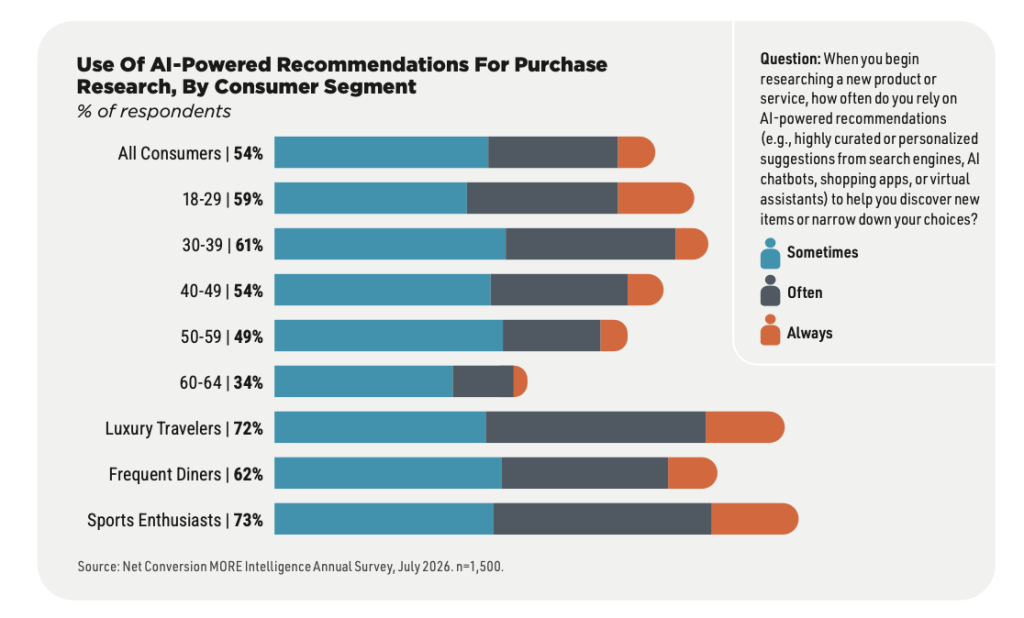
- 54% of consumers say they now use AI tools at least sometimes to research purchases.
- 54% also say they trust a brand less when they can tell its advertising or marketing was produced by AI.
The percentages are identical. The attitudes behind them are anything but.
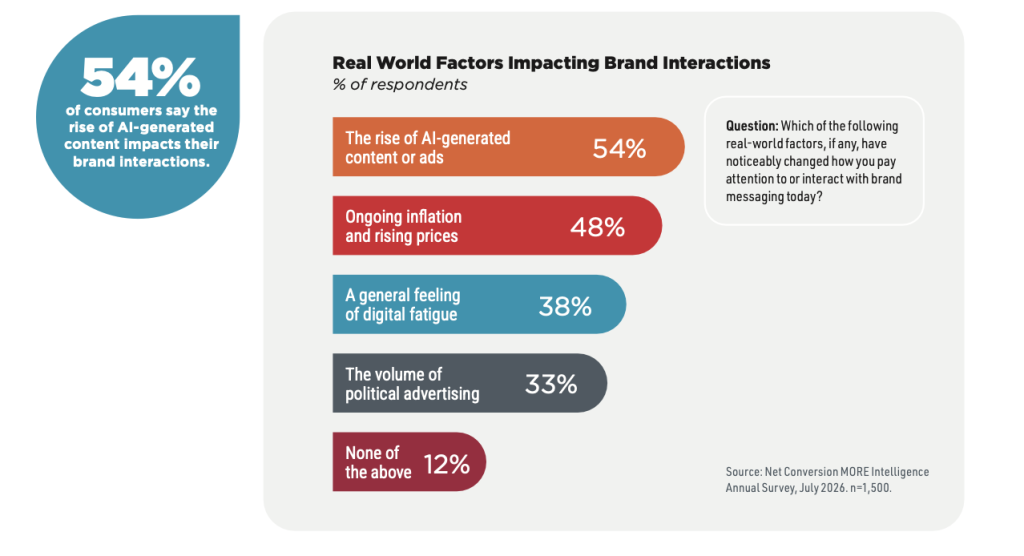
The study, conducted among 1,500 U.S. adults aged 18–64 with household incomes of $50,000 or more who had recently made a significant non-essential purchase, suggests that consumers aren’t simply deciding whether they like or dislike AI. They are making increasingly sophisticated distinctions about when it is useful, who controls it and what role they want it to play.
And those distinctions may have significant implications for marketers.
AI works differently when the consumer controls it
“For consumers, there is a clear difference between AI as a helpful tool and AI as a replacement for human storytelling,” says Ryan Fitzgerald, CEO and co-founder of Net Conversion.
His explanation goes to the heart of the apparent contradiction.
“When shoppers use AI, they stay in control. The tool functions as a research assistant and provides information on the shopper’s terms, which they can check against other reliable sources.”
But when brands use AI to create advertising or content, Fitzgerald argues, the relationship changes. Consumers may interpret that use as signaling “less effort, authenticity, and human care,” potentially undermining rather than building trust.

“When shoppers use AI, they stay in control.”
— Ryan Fitzgerald, CEO and co-founder of Net Conversion.
In other words, the research may not be revealing conflicting attitudes toward AI at all. It may be revealing something about agency and the independence of the modern buyer.
When consumers summon AI to compare products, summarize reviews, answer questions, or find alternatives, technology is increasing their ability to make a decision. When AI appears to be used primarily to make marketing cheaper, faster, or easier for the company producing it, the value exchange can feel very different.
That distinction becomes especially interesting among younger consumers.
AI use for purchase research rises to 60% among adults under 40. Yet adults aged 18–29 also register the strongest negative reaction to advertising they perceive as AI-generated: 38% “strongly agree” that they trust a brand less when its advertising or marketing appears to have been produced by AI.
The people becoming most accustomed to using AI may therefore also be among those developing the most exacting expectations for how brands use it.
Discovery is becoming a verification loop
The research also challenges a simple assumption about AI and the customer journey: that increasingly capable AI tools will steadily take over more of the purchasing decision. So far, consumers appear to be doing something more nuanced.
AI is becoming a powerful discovery mechanism.
Among consumers who use AI for purchase research,
- 74% say its recommendations expand the number of brands they consider.
- 45% say an AI recommendation actually increases their trust in a brand.
That potentially gives unfamiliar brands an entirely new way into the consideration set. But getting onto the list isn’t the same as winning the sale.
Ryan Fitzgerald describes what happens next as a “verification loop.”
“An AI recommendation is only the starting point,” he says. “Shoppers almost immediately enter a verification loop, turning to brand sites, search, YouTube, and Reddit to validate what they’ve learned.”
The full research makes the pattern strikingly clear. Consumers turn to brand websites, search engines and retailer product pages to verify facts; YouTube provides visual evidence of products in action; Reddit and other peer-driven environments supply opinions and real-world experience.
And despite the rapid development of autonomous AI agents, only 2% of respondents say they are comfortable handing the entire purchase process to AI—for example, allowing it to fill a shopping cart or book travel.
Perhaps, then, the rise of AI isn’t making consumers more passive.
It may be making them more demanding.
A brand increasingly has to pass two tests: Can AI find and recommend me? And then: When the consumer goes looking for evidence, does everything else about me support that recommendation?
That has practical consequences for marketers. Ryan Fitzgerald points to Generative Engine Optimization, or GEO, as one emerging requirement: brands need accurate, current, and accessible information if they expect AI engines to understand and recommend them.
But optimization alone cannot complete the journey.
If AI initiates discovery while consumers build confidence elsewhere, consistency across brand sites, retailers, search, video, social and peer commentary becomes increasingly important. The challenge isn’t merely appearing in an AI answer. It’s being able to withstand the investigation that answer triggers.
The attention problem may not simply be an attention problem
The research also places AI adoption within a broader change in media behavior.
Consumers report spending more time with AI assistants than a year ago, alongside increased time with YouTube and streaming video. Yet their tolerance for digital advertising is declining.
More than half—52%—say they are actively tuning out, skipping or blocking digital advertising more often than they were a year ago. Nearly half frequently encounter the same advertising across multiple platforms, while 34% frequently see advertising unrelated to their location, age or interests.
It is tempting to interpret this simply as another symptom of shrinking attention spans. Ryan Fitzgerald sees something else. “Consumers are navigating both increasingly fragmented attention and messaging overload,” he says. But the problem, he argues, also lies in “uncoordinated media activities,” including excessive repetition and poor targeting that force audiences to defend their own mental bandwidth.
That’s an important distinction. Attention may not simply be disappearing. It may be moving—and becoming more deliberately allocated.
Consider another finding: 88% of respondents regularly use a second device while watching television. Yet that divided attention isn’t necessarily useless attention. One-quarter say they search for a brand on their phone immediately after seeing its advertisement on TV, rising to 31% among adults under 40.
The consumer who appears distracted may actually be moving from exposure to investigation. Once again, verification enters the picture.
For media planners, Fitzgerald argues, this should shift emphasis away from sheer impression volume and toward coordinated frequency, higher-quality placements and measurement that captures what people actually do after exposure.
Perhaps the more useful question isn’t simply, How do we capture attention?
It is: What happens once we have it?
Loyalty hasn’t disappeared. It has become conditional.
The broader consumer environment matters here.
Net Conversion’s research finds that the sharp erosion in brand loyalty seen during 2025 has slowed considerably. Sixteen percent now say they are less loyal to brands than a year ago, compared with 34% in January 2026 and 40% in July 2025.
But stabilization isn’t the same as devotion.
The full study characterizes the new baseline as conditional loyalty: consumers may remain with brands, but they expect those brands to continue earning the relationship through value, ease and relevance.
That idea connects surprisingly well with the AI findings.
Consumers appear willing to use technology that saves them time, gives them better information or expands their choices. They are less enthusiastic when technology seems primarily to benefit the marketer.
They tolerate advertising that helps them move toward something they want. They become more adept at avoiding advertising that feels repetitive, irrelevant or intrusive.
And they may remain loyal—but increasingly because the brand continues to earn that loyalty rather than because switching feels unthinkable.
Across these behaviors runs a common thread: the consumer is exercising greater control.
From demographics to moments of intent
That may also explain another of Net Conversion’s conclusions: marketers need to think increasingly in terms of intent rather than demographics.
Traditional demographic categories remain useful descriptors, but Fitzgerald argues they are poor proxies for buying readiness. “Legacy demographic buckets like ‘Women 25–54’ fail to capture actual buying readiness,” he says. “Today, targeting should focus on real-time behavioral signals, consumer mindset, and contextual intent.”
That shift changes more than media targeting.
It means recognizing the consumer arriving from an AI-generated shortlist. The television viewer who reaches for a phone after seeing something interesting. The shopper comparing reviews rather than simply scrolling past an impression. The existing customer whose loyalty depends on whether a brand continues to save time, provide value or make the relationship worthwhile.
These are not merely audience characteristics. They are moments of behavior.
And perhaps that is one of the more important lessons in the research.
For all the understandable fascination with what artificial intelligence will enable marketers to automate, optimize and produce, consumers are developing their own uses for the technology at the same time.
- They are using AI to discover more.
- Then they are checking what it tells them.
- They are filtering more advertising.
- They are moving between screens.
- They are reconsidering loyalty.
And they are leaving marketers with an intriguing new challenge: technology may make it easier than ever to reach people, while simultaneously giving people more power to decide what deserves their attention and trust.
The opportunity, then, may not lie in using AI to remove more of the human element from marketing.
It may lie in understanding where technology genuinely helps people—and where human judgment, creativity, consistency and care become more important precisely because technology is everywhere.
Because the modern consumer doesn’t appear to be rejecting AI.
The modern consumer appears to be deciding what AI is for.