
The Hidden Cost of Global Marketing
The Big Idea Is Only as Strong as the System That Delivers It.
Global brands have never invested more in creating big ideas.
Brand platforms are centralized. Creative systems are increasingly sophisticated. Campaigns are built to travel across markets, formats, platforms, and channels. Strategy is aligned. Guidelines are documented. Master assets are approved.
And yet, what consumers actually experience is often far less coherent.
A campaign launches globally. Then it begins to move. It is resized, translated, reformatted, localized, platform-adapted, rebuilt by agencies, adjusted for market realities, and optimized for performance.
Each individual decision may seem reasonable. Each change may be justified. Each market may have a valid explanation.
But collectively, something important can happen. The idea becomes harder to recognize.
The visual identity shifts. Distinctive assets become less consistent. Messaging priorities change. Layouts evolve. Brand signals weaken. What began as one powerful idea gradually becomes many slightly different versions of itself.
This is one of the hidden paradoxes of modern marketing.
Brands invest heavily in strategy, creativity, agencies, technology, production, and localization. Yet many still struggle to preserve the integrity of the very ideas they invested millions to create.
When Adaptation Becomes Accumulation
For years, marketing organizations have treated scale primarily as a production challenge.
More assets. More formats. More personalization. More localization. More speed.
But the real challenge may no longer be producing enough content.
It may be preserving the commercial power of an idea as it travels.
Consumers do not experience brands through strategy decks.
They experience brands through thousands of distributed moments across channels, formats, agencies, markets, retailers, platforms, and contexts.
And in those moments, small executional decisions matter.
A local adaptation can increase relevance—or weaken recognition.
A rebuilt layout can fit a format—or dilute distinctiveness.
A performance edit can improve response—or move the asset further away from the brand.
A translated message can connect locally—or lose the emotional force of the original idea.
None of these decisions appear significant in isolation.
Together, they shape what consumers actually experience.
The challenge is no longer creating a strong global idea. It is ensuring that idea remains recognizable as it travels.
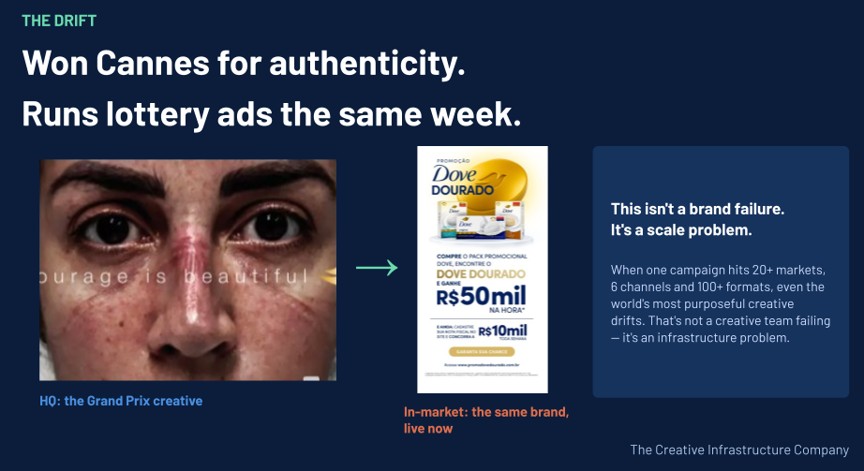
A campaign can be globally celebrated for one idea while appearing very differently across markets, channels, and local executions. The challenge is rarely a single decision—it is the accumulation of many adaptations over time.
Recent analysis by Zuuvi of global campaign executions across markets suggests that significant variations can accumulate as ideas move across markets, agencies, formats, and platforms.
A Systems Challenge, Not an Agency Challenge

Examples from automotive, consumer goods, and financial services illustrate how brand expressions can diverge across markets, formats, and local adaptations. According to Zuuvi, the challenge is rarely one major deviation—it is the accumulation of hundreds of small changes over time.
Sometimes those adaptations strengthen local relevance. Sometimes they weaken recognizability.
Importantly, this is not simply an agency problem. Nor is it a market problem. Nor a compliance problem. It is a systems problem.
Hundreds of reasonable decisions can collectively create unintended outcomes. The issue is rarely one catastrophic mistake. More often, it is the accumulation of executional decisions over time.
If these deviations occur within some of the world’s most sophisticated marketing organizations, the implication is significant.
The challenge is not poor execution. It is that the current operating model for scaling creative content is under increasing pressure.
Why Creative Infrastructure Matters
This is where the concept of creative infrastructure becomes increasingly important.
Not simply as workflow management. Not merely as production efficiency.
But as a strategic layer that helps brands maintain coherence, recognizability, and control as ideas move through increasingly complex global marketing environments.
The big idea is only as strong as the system that delivers it.
That is the challenge platforms such as Zuuvi are designed to address.
Rather than replacing creativity, creative infrastructure helps organizations protect the value of creativity as it scales.
It enables marketing teams, agencies, and local markets to adapt and deploy creative assets within a controlled framework that preserves consistency while allowing flexibility.
That distinction matters.
Because the future challenge for global brands is not simply how to create more content.
It is how to create more content without becoming less recognizable in the process.
Historically, drift occurred gradually. In the AI era, it may happen at unprecedented speed. As organizations gain the ability to generate, adapt, localize, and personalize content at scale, the number of brand expressions entering the market will increase dramatically. Without stronger systems, consistency may become harder to maintain precisely when it becomes more valuable.
Recognizability as a Competitive Advantage
As AI accelerates content creation, localization, and adaptation, the volume of brand expressions will multiply dramatically.
The risk is not simply that brands create more content.
The risk is that they create more inconsistency, faster.
In that environment, recognizability may become one of marketing’s most valuable assets.
The next competitive advantage may belong not only to the brands with the strongest ideas.
But to the brands with the infrastructure capable of protecting those ideas as they move through the real world.
The brands that win will not simply be those that create great ideas.
They will be the brands capable of keeping those ideas recognizable, distinctive, and commercially effective wherever they appear.ts.