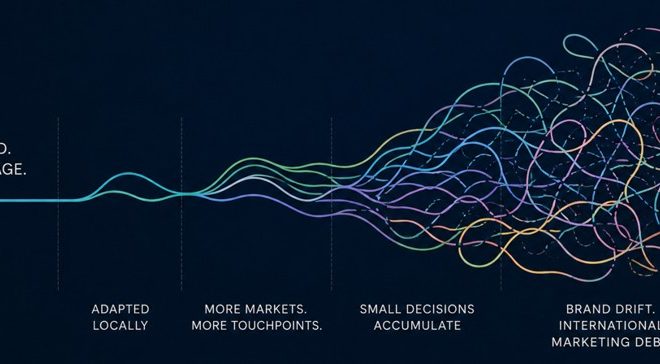
Signal: The Age of Scaled Sameness
If AI risks making brands invisible through sameness, marketing’s real work is to build a collaborative architecture of meaning, authenticity, and trust that creates enduring relationships and distinguishing relevance — which become the actual drivers of value and true growth.
For years, marketers have worried about distrust. But the more immediate danger may be quieter and colder: indifference.
Most brands are not actively disliked. They are simply optional. In an environment saturated with content, optimization, and algorithmic targeting, invisibility is no longer caused by lack of reach. It is caused by lack of resonance. AI threatens to amplify this condition. When tools designed to optimize efficiency produce waves of competent but interchangeable communication, sameness scales faster than differentiation.
The result is not outrage. It is apathy. And apathy is where trust cannot take root.
Trust is not soft — it is structural
The industry often treats trust as an emotional aftereffect: something earned if a campaign feels authentic or a message lands well. But long-term effectiveness research suggests something more rigorous. Campaigns that deliberately build trust are disproportionately likely to drive significant business effects across sales, profit, market share, and loyalty trustanalysisjan2026_final. Trust behaves less like a sentiment and more like a multiplier.
Yet trust does not exist in isolation. It sits inside a system.
A useful way to understand that system is through three distinct but interlocking ideas that marketing language often blurs together:
- Meaning is relevance in people’s real lives. It answers the basic question: why should anyone care? Meaning is the antidote to indifference.
- Authenticity is alignment between what a brand claims and how it behaves. It prevents communication from drifting into performance without substance.
- Trust is accumulated confidence that a brand will reliably deliver on its promises over time.
When these three operate together, they form an architecture. Meaning attracts attention. Authenticity sustains credibility. Trust compounds through consistent experience. Remove any one element and the structure weakens.
AI reframes the architecture
Artificial intelligence does not eliminate the need for this architecture — it intensifies it.
AI can generate content that looks meaningful without being rooted in lived relevance. It can simulate authenticity without organizational alignment. It can distribute messages at a speed that outpaces the slower work of earning trust. In other words, AI can scale the appearance of connection while quietly eroding its substance.
This is why the central challenge for modern marketing is not technological adoption alone. It is system design. The question is no longer simply how to use AI more efficiently. It is how to embed AI inside an ecosystem that strengthens meaning, reinforces authenticity, and protects trust.
That ecosystem is inherently collaborative. Brands do not build trust in isolation. They do so through networks of agencies, platforms, partners, employees, and communities. When those actors operate with shared clarity about purpose and standards, communication becomes coherent rather than fragmented. When they do not, sameness creeps in — not because of lack of creativity, but because of lack of alignment.
From attention to relationship
The real opportunity for marketers is to shift the objective from capturing attention to cultivating relationship.
Attention is abundant and fleeting. Relationship is scarce and durable. It is built when brands demonstrate meaningful relevance, behave authentically across touchpoints, and deliver consistently enough to earn confidence. In such environments, trust stops being a soft virtue and becomes a practical operating advantage.
This reframing also restores a human dimension to marketing that can feel threatened by automation. People do not form relationships with algorithms. They form them with entities that show up reliably in their lives with something of value to offer. Technology can accelerate that exchange, but it cannot substitute for its substance.
Designing for distinguishing relevance
The brands that escape indifference are not necessarily the loudest or the most technologically advanced. They are the ones that design deliberately for distinguishing relevance — relevance that is both meaningful and differentiated. They understand that sameness is the natural byproduct of efficiency, and that architecture is required to resist it.
That architecture is built from choices: what a brand stands for, how it behaves, how it collaborates with partners, and how it integrates new tools without diluting its core. These are not cosmetic decisions. They are structural commitments that determine whether communication accumulates into trust or dissipates into noise.
In an AI-saturated marketplace, the temptation is to chase speed and scale. The smarter move is to invest in the systems that make speed and scale worthwhile. Meaning, authenticity, and trust are not nostalgic ideals from a pre-digital era. They are the conditions that allow modern marketing to produce enduring relationships and distinguishing relevance.
And it is in those relationships — not in optimization alone — that value and true growth begin.
A version of this essay appears on Deborah Malone’s Substack as part of her ongoing exploration of marketing in the AI era.
Global Marketing at the Crossroads — a personal Substack by Deborah Malone offering reflective insight on marketing’s inflection points, beyond headlines and hype.