
What If Marketers Are Asking the Wrong Questions About Consumers?
New research challenges the assumptions behind generational targeting — and reveals why understanding how people experience change may matter more than the categories we assign them.
A Fortune 100 consumer goods company had a question for New York branding agency Beardwood after a presentation on its research into Gen Alpha: What did the findings mean for an organization that had been instructed to focus exclusively on Gen Z?
It’s a revealing question about how marketing organizations define their audiences.
Generational targeting offers a convenient way to organize consumers, establish priorities, and communicate strategy. But what happens when those categories become so ingrained that they limit a brand’s ability to recognize opportunities elsewhere?

Ryan Lynch, Co-CEO of Beardwood, believes marketers may be overlooking the relationships and motivations that connect consumers across generations.
“Most marketers underestimate the flywheel of cross-generational brand building,” he says, pointing to the agency’s Gen Alpha research showing that tweens and parents influence one another’s brand choices.
Yet another Beardwood study, AgeFree in America, raises an even more fundamental question: How much does knowing someone’s age actually tell us about what they think, feel, and want?
When the Research Challenges the Assumptions
Beardwood’s AgeFree in America began with a deceptively simple question: How do people actually feel about aging, and how does that influence their relationships with brands?
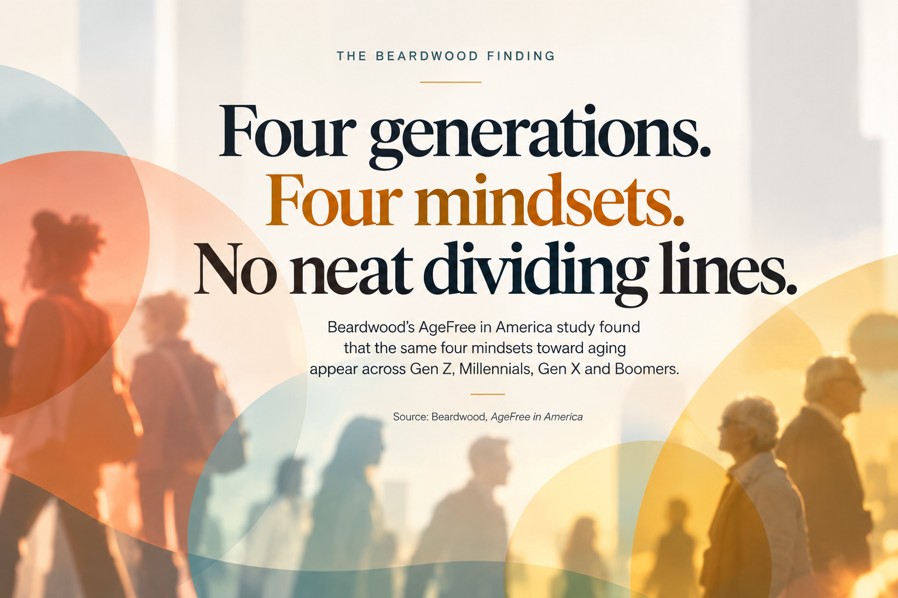
Drawing on a survey of 1,037 Americans and 194 conversational interviews, with representation across Gen Z, Millennials, Gen X, and Boomers, the research uncovered a surprisingly complicated picture. People simultaneously accept and resist aging. They recognize its physical realities while rejecting many of the identities society attaches to it. And their attitudes don’t necessarily align with the generation to which they belong.
Beardwood identified four mindsets: the Obsessed, the Braced, the Unbothered, and the Self-Authored. These reflect different combinations of anxiety about aging and willingness to embrace aging-related products and promises.
What surprised the researchers was how widely these mindsets appeared across generations.
“We had to really emphasize that every generation was represented equally across mindsets, because you would expect cohorts based on life stage or lived experience,” Ryan Lynch explains. The distribution isn’t identical across generations, but the broader finding challenges the assumption that people born around the same time necessarily share the same attitudes toward growing older.
Importantly, Beardwood doesn’t propose replacing traditional demographic categories with four new consumer boxes. Lynch describes the mindsets as guidelines for understanding how people may respond to brands, not permanent identities or universal targeting segments.
That distinction matters. Age remains relevant, but it is an incomplete explanation of consumer motivation.
When Marketing Becomes Part of the Problem
Perhaps the study’s most revealing finding concerns an industry built around helping people feel better.
Thirty-eight percent of respondents say wellness has made them more anxious about aging. Another 40% agree that wellness culture is largely fear of aging in disguise. The contradiction is striking. An industry promising improvement may also be reinforcing the insecurities that make improvement seem necessary.
Ryan Lynch sees a disconnect between what brands promise and what consumers actually want. “They want wellness that helps them feel like themselves, not some optimized version of themselves,” he says.
In the research, respondents favored living better and feeling more like themselves over simply living longer or looking younger. Beardwood calls that feeling AgeFree.
It’s not necessarily about denying age or pretending its effects don’t exist. Rather, it’s about being able to pursue interests, enjoy experiences, and make choices without constantly being reminded of a demographic identity.
For marketers, the implication reaches beyond wellness. Is a brand making someone’s life better, or persuading them that something about their life needs correcting?
Design for the Need, Not the Label
One of the most practical implications of the research concerns product design.
Consider OXO Good Grips, originally developed to address difficulties associated with arthritis but marketed as better-designed kitchen tools for everyone. The product recognizes a genuine physical need without requiring consumers to identify themselves through that limitation. Ryan Lynch also points to simplehuman, whose household products emphasize ease and efficiency, and Rare Beauty, which has incorporated accessibility considerations into its packaging and product design.
These examples suggest a distinction between recognizing how people’s needs change and making those changes the centerpiece of a marketing message. He emphasizes, brands should “treat them as humans and design for how they are changing without talking about it.”
Of course, not every age-related need can or should disappear from communication. Accessibility, health, financial circumstances, and life stages remain important considerations. But identifying a need is different from assuming that everyone of a particular age experiences it in the same way.
Better design can begin with specific human circumstances and create benefits that extend far beyond the audience originally imagined.
A Question Beyond America
Although AgeFree examines American consumers, Ryan Lynch believes its implications may extend further. He acknowledges that cultural attitudes toward aging, mortality, and personal reinvention vary considerably. Americans, he suggests, may be especially inclined to view aging as something they can manage or change, reflecting broader cultural beliefs about individual agency.
Yet he suspects that some of the underlying anxieties and motivations identified in the research may appear in other markets, even if their expression and relative importance differ. That remains a hypothesis rather than a finding of the study. But it raises an intriguing question for global marketers: Could understanding how people relate to change offer more insight than assuming consumers of similar ages share similar expectations?
Lynch offers a concise challenge to CMOs: “Age = change. Market/design/strategize for the changes.”
Perhaps the larger opportunity isn’t to make age irrelevant. It’s to recognize that chronological age is only one part of a much more complex human experience. After all, people don’t stop developing new interests, discovering brands, influencing others, or reconsidering what matters to them simply because they’ve crossed a particular birthday.
The challenge for marketing is to understand what changes in people’s lives, what remains important to them, and why neither can be captured by age alone.
This article is part of The Internationalist’s GenMORE+ initiative, exploring the opportunities for brands to build stronger connections across generations.