
How Wide Is Your Swim Lane?
Nike, “Iron Nun,” and the growing tension between performance, participation, and belonging.
Sometimes it’s the smallest things that don’t last very long that stay with you.
A line of copy. A window message. Something that appears, sparks reaction, and disappears within a day.
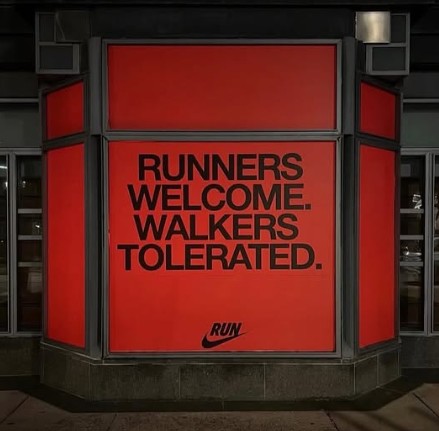
During marathon week in Boston—as the 130th Boston Marathon unfolded on Patriots’ Day, Monday, April 20, 2026—Nike placed a simple message in a store window:
“Runners Welcome. Walkers Tolerated.”
It was removed quickly.
The reaction was immediate—and varied. Some saw it as a sharp expression of competitive edge. Others, including industry voices, pointed to how quickly the line narrowed a category that has been steadily expanding.
But what makes moments like this interesting isn’t the speed of the response—or even the decision to take something down. That has become part of the rhythm of modern marketing.
What lingers is the question it raises.
A Brand That Knows This Balance
Few brands have managed the balance between elite performance and broad participation as consistently—or as effectively—as Nike.
It has built its identity on both:
- the pursuit of excellence at the highest level
- and the enduring belief that athleticism isn’t reserved for the few
That duality has been one of its greatest strengths.
Which is what made this moment feel less like a shift in strategy—and more like a rare instance out of step with its own legacy.
The issue wasn’t the presence of an edge.
It was how that edge was expressed.
Expanding, Not Lowering, the Bar
That distinction becomes clearer when looking at Nike at its best.
In The Internationalist’s GenMORE+ Index, one of the campaigns that resonated most consistently across generations was Nike’s “Iron Nun”—a story of endurance, discipline, and lifelong athleticism.
It didn’t redefine sport by making it easier.
It redefined it by making it broader.
Endurance wasn’t framed by speed alone, but by persistence. Not just peak performance, but the ability to continue—over time, and on one’s own terms.
In that sense, the campaign didn’t stretch Nike’s identity.
It expressed it fully.
Where the Market Is Moving
At the same time, the category itself is evolving.
Brands like Skechers have built meaningful growth by focusing on walkers, comfort, and everyday movement—areas that were once overlooked, but are now central to the market’s expansion.
And Hoka has gained momentum by combining performance credibility with a more accessible, supportive approach—embracing not only elite athletes, but those extending their range, returning from injury, or redefining what progress looks like.
These aren’t secondary audiences.
They are where much of the growth is happening.
The Edges of Belonging
In today’s environment, brands are often encouraged to define their “swim lanes” more clearly.
To focus.
To prioritize.
To build deeper relationships with those most likely to care.
And that instinct is right.
But it comes with a responsibility.
Because once people feel invited in, they don’t experience themselves as peripheral. They see themselves as part of the brand’s world.
Which means the challenge isn’t simply deciding who you are for.
It’s understanding how far that sense of belonging already extends—and staying true to it.
Consistency at the Edges
Nike’s moment in Boston will fade quickly.
But the underlying tension it revealed is likely to remain relevant—not just for Nike, but for any brand navigating the balance between focus and inclusivity.
Because in a market shaped by constant feedback and evolving expectations, brands aren’t judged only by who they target.
They are judged by how consistently they reflect the people who already believe they belong.
The real challenge isn’t choosing a lane.
It’s understanding how wide it already is—and holding that line at the edges.
For a brand built on the idea that everyone is an athlete, the real test isn’t performance—it’s consistency.