From Growth Engine to Navigation System: Marketing’s Expanding Role
Uncertainty is not new to marketing.
But the structure of uncertainty is changing—and with it, the role marketing is expected to play.
New research from the World Federation of Advertisers (WFA), developed in partnership with transformation consultancy The Intangibles, suggests that today’s environment is not simply more volatile. It is more complex, more interconnected, and less predictable than in previous cycles.
More than 90% of senior marketers say the business environment is riskier than it was 12 months ago, and nearly eight in ten say it no longer feels like business as usual.
But beneath those headline numbers lies a deeper shift—one that signals a broader Marketing Reset.
THE PRESSURE, BY THE NUMBERS
97%
… say budgets are under heavier scrutiny
70%
… are pushed toward short-term decisions
48%
… see more challenges than opportunities
1. Risk Is No Longer Linear
Historically, marketers have navigated cycles of economic pressure, regulatory change, or competitive disruption.
Today, those forces are converging.
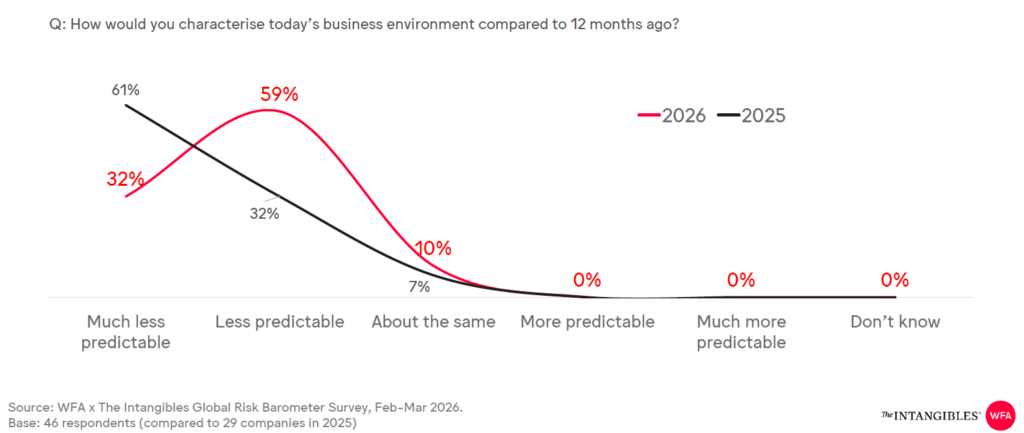
Geopolitical instability, economic uncertainty, and rapid advances in technology—particularly AI—are no longer separate challenges. They are interacting in real time, amplifying one another and reshaping decision-making conditions.
Nearly half of respondents do not believe there are more opportunities than challenges in today’s environment.
That distinction matters.
Because when risk becomes dynamic rather than discrete, it is no longer something to manage periodically. It becomes something to navigate continuously.
“Marketers are used to navigating risk, but the interplay of geopolitical, economic, and tech-driven uncertainties makes this a uniquely complex operating environment… at a time when budgets are facing unprecedented scrutiny,” said WFA’s CEO Stephan Loerke.
Predictability Is Declining—But Not Evenly
2. The System Is Tilting Toward the Short Term
At the same time, internal pressures are intensifying.
Budgets are under heavier scrutiny than at any point in recent years.
Organizations are increasingly focused on immediate objectives.
And marketing teams are being asked to deliver more with fewer resources.
This creates a structural tension.
Long-term thinking is essential in uncertain environments.
But the system itself is increasingly optimized for short-term accountability.
For marketers, that tension is not theoretical. It is operational—affecting how decisions are made, how success is measured, and how risk is assessed.
3. Marketing Is Moving to the Center of Risk
Perhaps the most significant shift is organizational.
Cross-functional collaboration is rising sharply, with marketing now working more closely with legal, strategy, corporate affairs, and policy teams to mitigate risk.
In many organizations, formal risk groups have been established, bringing together disciplines that historically operated independently.
At the same time, boards are placing greater expectations on marketing leaders to develop formal risk mitigation strategies and frameworks.
This signals a fundamental change: Marketing is no longer adjacent to risk discussions.
It is becoming a core participant in them.
4. The Cost of Caution
As risk rises, so does caution.
And that caution is beginning to shape not just how decisions are made—but what gets made.
Many organizations report increased internal deliberation, greater due diligence, and heightened sensitivity around how brands position themselves externally.
In this environment:
- Creativity can be constrained
- Campaigns are more heavily scrutinized
- Long-term brand building becomes harder to defend
- And internal alignment takes more time and effort
At the same time, traditional ROI models are struggling to justify long-term investment—making it even more difficult to prioritize future value over immediate results.
The result is a system where caution is necessary—but can also become limiting.
5. From Growth to Navigation
For decades, marketing has been defined by its ability to drive growth.
That responsibility remains.
But it is no longer sufficient.
Today’s environment requires marketing to also:
- interpret shifting external conditions
- align internal stakeholders
- balance competing time horizons
- anticipate second-order effects of decisions
In other words, marketing is evolving from a growth engine into a navigation system.
Conclusion: A Different Definition of Effectiveness
If marketing is becoming more deeply embedded in how organizations navigate risk, then its definition of effectiveness must evolve as well.
Not just:
- reach
- engagement
- short-term performance
But contribution to:
- alignment
- resilience
- long-term value creation
This is the essence of the Marketing Reset.
And it suggests that the most effective marketers going forward will not simply be those who can drive growth— but those who can do so while navigating uncertainty with clarity and conviction.
Source: WFA Global Risk Barometer 2026, developed in partnership with The Intangibles.
Part of The Internationalist’s ongoing exploration of the Marketing Reset.