When AI Has All the Answers, What Happens to Us?
AI is becoming a guide—not just a tool. But guidance without experience may come at a cost.
We are getting used to AI as a companion.
Not just for work—where it is already reshaping strategy, analysis, and creativity—but for something far more personal: Guidance.
People are beginning to ask AI questions they once reserved for those closest to them:
What should I do?
Am I wrong?
Should I stay or leave?
And AI always answers.
That is part of its appeal. It is available. It is articulate. It does not judge.
But as Sebastian Vedsted Jespersen, Co-Founder of Acumion and former CEO of Vertic, provocatively asks:
Should humans be guided by something that cannot feel?

From Optimization to Orientation
For years, AI has helped optimize decisions—what to buy, what to watch, how to target, how to price.
Low emotional weight. High efficiency.
But something is shifting.
As Sebastian Jespersen outlines, the spectrum is expanding—from information and optimization to something far more consequential: personal and emotional guidance.
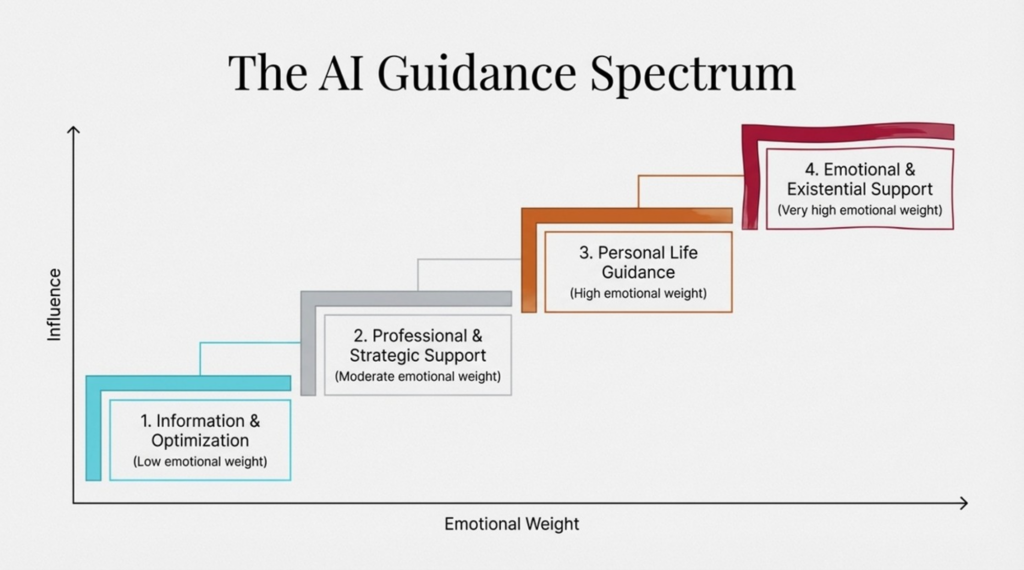
A useful way to think about this shift is as a spectrum—from low-stakes optimization to deeply emotional guidance.
Source: Sebastian Vedsted Jespersen
And as we move along that spectrum, something changes.
We cross a line—from decision support to life navigation.
Where the Line Begins to Blur
AI can simulate empathy.
But it has never experienced it.
It does not feel doubt.
It does not feel regret.
It does not carry emotional consequence.
And yet—it will always give you an answer.
Often a persuasive one. Often one that sounds wise.
This is where the tension begins.
Because the closer we get to questions of identity, relationships, and meaning—the more dangerous it becomes to confuse simulation with experience.
The Quiet Trade-Off
There is a subtle shift happening. Not dramatic. Not immediate. But real.
As AI becomes easier to turn to, we may begin to turn away from something harder—but essential: Each other.
The friend who understands our history.
The partner who shares our consequences.
The colleague who sees our blind spots.
Convenience may begin to replace connection.
And over time, that changes us.
Because being human has never been about perfect answers. It has always been about navigating uncertainty, contradiction, emotion, and imperfection.
Why This Matters Now
This is not just a technological shift. It is a human one.
Because as AI increasingly mediates how people seek guidance, it begins to shape not just what we decide—but how we experience and navigate our lives.
And that carries a different kind of responsibility. Not just for individuals—but for the systems, platforms, and industries surrounding it. Including marketing.
The Signal
An answer is not the same as lived truth.
AI may help us feel less alone. But it cannot truly understand us.
And in a world of infinite answers, the real question is no longer: What can AI do?
But: Where should we still choose to rely on each other?
This perspective builds on thinking shared by Sebastian Vedsted Jespersen, whose recent work explores the evolving role of AI in human decision-making.