When Brands Know When to Step In—and When to Step Back
There are moments when brands are expected to act.
And others when they simply have the opportunity.
The difference isn’t always obvious.
But how brands respond—especially in small, unscripted situations—can reveal far more than any campaign.
Recently, a quiet story out of Japan captured global attention.
A young macaque monkey named Punch, rejected by his mother, was filmed carrying around a plush toy for comfort. The internet did what it does—turning the moment into a wave of shared emotion, humor, and commentary.
At the center of it all was a simple product: a stuffed toy from IKEA.
It would have been easy—almost expected—for the brand to amplify the moment.
To create content, insert messaging, or build a campaign around a viral story already in motion.
Instead, the response was quieter.

IKEA Japan reportedly visited the zoo and donated replacement toys.
No headlines.
No call to action.
No attempt to “own” the moment.
At a time when nearly every cultural spark can be turned into content, restraint stands out.
Because it reflects something increasingly rare in modern marketing: judgment.
The Discipline Behind Restraint
Today, brands are equipped to respond instantly.
Social listening tools flag opportunities in real time.
Content teams can produce and publish within hours—sometimes minutes.
Distribution is frictionless.
The question is no longer whether a brand can show up. It’s whether it should.
And increasingly, the most meaningful brand decisions are not about speed or visibility—but about appropriateness. This means understanding:
- the tone of the moment
- the emotional context
- and the role a brand should—or should not—play
A Different Kind of Participation
We see this instinct expressed differently—but just as deliberately—across countries often grouped together, but distinct in how they show up.
In Sweden, initiatives from Visit Sweden, led by Nils Persson, have focused on redefining what destination marketing can be.
Campaigns like #YourSwedishIsland and The Swedish Prescription move beyond traditional tourism imagery—inviting people not just to visit, but to experience Sweden differently. One democratizes the idea of luxury by opening access to the country’s vast natural resources. The other reframes nature itself as something restorative—something to be felt, even “prescribed,” rather than promoted.
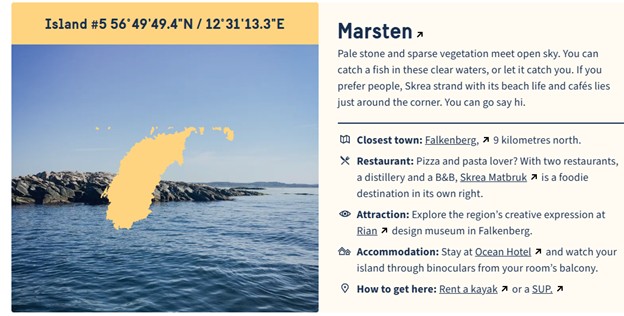
Sweden has more islands than any other country. 267,570, to be exact, and the latest Visit Sweden campaign has awarded five winners with the opportunity to “own” a designated Swedish island for one year. Above is an example of one of the private islands: Marsten.
Finland, often ranked the happiest country in the world, approaches this from a different—but equally intentional—place.
Rather than telling people what Finnish summer looks like, the recent #ChillLikeAFinn campaign invites them to imagine it for themselves—turning social media into a casting call where the audience becomes the storyteller.

It’s a subtle but significant shift: not a campaign about a place, but a platform for participation.
And beneath it is a deeper truth.
Finland’s positioning isn’t constructed—it’s lived. The country’s long-standing focus on wellbeing, education, nature, and balance shapes not just its messaging, but its reality. Happiness, as the data suggests, is not a slogan. It’s a system.
Different expressions—but the same understanding of what people need right now.
From Messaging to Behavior
These examples may seem small or situational. But they point to something larger. Not just a shift in how marketing is executed, but in how it is understood.
For years, the focus has been on what brands say: their messages, their positioning, their purpose.
Now, the emphasis is moving elsewhere. Toward what brands do— and how they behave in moments that aren’t planned, scripted, or optimized.
This is where many organizations feel the tension.
Because the systems have been built for:
- amplification
- optimization
- and scale
But not for restraint. Not for nuance. Not for deciding when not to act.
The Human Layer
In a world where every moment can be captured, analyzed, and amplified instantly, restraint becomes more than a strategic choice.
It becomes a human one.
Care.
Empathy.
A sense of proportion.
These aren’t typically framed as marketing capabilities.
But they are increasingly what distinguish brands that feel authentic from those that feel reactive.
Because when everything can be optimized, accelerated, and scaled, what matters most is judgment.
And judgment, at its core, is human.
Even the most purpose-driven organizations are recognizing this shift.
At Patagonia, the integration of marketing and impact reflects a belief that storytelling and action are inseparable.
But just as important is how—and when—that action shows up.
Because not every moment calls for amplification. Some call for something simpler.
A Different Kind of Impact
For years, the conversation around marketing’s role in the world has focused on purpose: What brands stand for. What they support. What they say.
But increasingly, impact is being judged differently. Not just by intention. But by behavior.
In the end, people don’t remember every campaign.
But they do remember how something felt.
Whether a brand:
- added something of value
- or simply added noise
Whether it participated or took over.
Sometimes that means stepping forward.
And sometimes, just as meaningfully, it means stepping back.
In marketing, as in life, the most meaningful actions aren’t always the most visible. But they are often the most human. In a world built for instant response, the brands that stand out may be the ones that know when not to.
This is where marketing is shifting…
… from what brands say to how they behave—and the impact that follows.