When Transformation Becomes the Default
If transformation is now the default, the question is simple: now what?
It’s easy to assume that marketing’s current challenges stem from complexity.
More channels.
More data.
More expectations.
But that may not be the real shift.
The deeper change is structural.
The conditions marketing operates within keep shifting.
From Phase to Condition
For years, transformation was something companies pursued.
A defined initiative.
A strategic priority.
A temporary disruption in service of long-term improvement.
That model is disappearing.
Research from the World Federation of Advertisers (WFA) in partnership with Ogilvy Consulting makes this explicit: nearly all major organizations (96%) are now in transformation mode, and most (80%) no longer see an endpoint.
Transformation has moved from project…
to permanent condition.
Why This Matters More Than It Seems
When transformation becomes continuous, it changes more than strategy.
It changes how organizations function.
And it changes what leadership requires.
Because a system that is always evolving cannot be managed in the same way as one that periodically resets.
The forces driving transformation are not isolated. They are structural and ongoing:
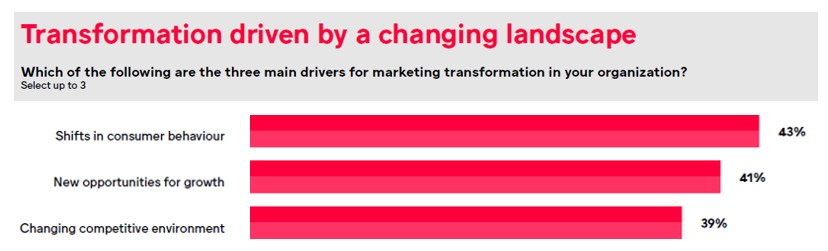
Source: WFA/Ogilvy Consulting, Global Brand Transformation research
The Role Reflects the System
This helps explain the growing instability in the CMO role.
Across industries, the role is:
- expanding into new areas
- fragmenting across functions
- compressing under increased scrutiny
These aren’t disconnected trends.
They are reflections of a system in motion.
The Leadership Factor
The most important insight from the WFA/Ogilvy research is not about transformation itself.
It’s about leadership.
The study suggests that success is less dependent on:
- access to technology
- scale of investment
- or clarity of strategy
And more dependent on how leaders interpret and respond to change.
As Stephan Loerke, CEO of the World Federation of Advertisers (WFA) has observed, leadership strengths can become vulnerabilities when over-relied on—creating predictable imbalances if not addressed.
The Transformer’s Paradox
The most effective leaders don’t transform constantly.
They don’t rely on disruption as a strategy.
Instead, they build organizations that can sustain change without losing coherence.
Which requires balance.
The research identifies four leadership archetypes:
- Strategic Visionary
- Capability Builder
- Culture Catalyst
- Adaptive Navigator
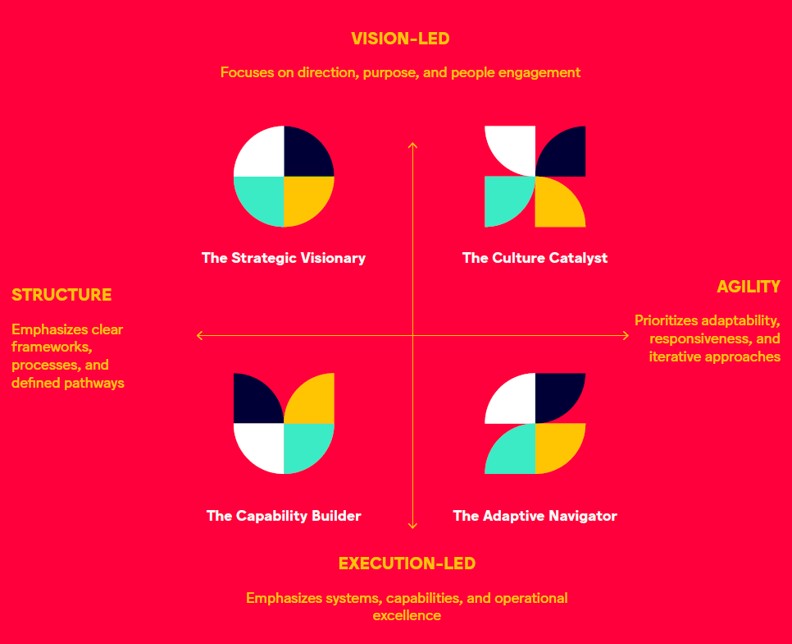
The WFA/Ogilvy research identifies four leadership archetypes for navigating continuous transformation.
Source: WFA/Ogilvy Consulting, Global Brand Transformation report
Each reflects a different way of navigating transformation.
But no single approach is sufficient on its own.
Because the same strength that drives progress can also create imbalance.
When Balance Is Lost
Transformation doesn’t fail because organizations aren’t trying hard enough.
It fails because leadership tends to over-index on familiar strengths.
Strategy without execution.
Execution without direction.
Culture without accountability.
Agility without alignment.
The result is not lack of change.
It’s misaligned change.
From Driving Change to Operating Within It
If transformation is permanent, then leadership must evolve accordingly.
The role of the CMO—and marketing more broadly—shifts from:
Owning transformation to operating within continuous change
This requires a different kind of capability:
- understanding not just what to do, but what’s missing
- building teams that compensate for individual bias
- maintaining alignment even as conditions shift
The New Leadership Reality
Transformation didn’t become more urgent.
It became permanent.
And in a system defined by constant change, the challenge is no longer how to transform—
but how to lead when transformation never ends.
Based in part on research from the World Federation of Advertisers and Ogilvy Consulting. Download the full “Global Brand Transformation” report here.
This article is part of The Internationalist’s Marketing Reset series—exploring how marketing is evolving as expectations, structures, and leadership models continue to shift.